Wondering how God is calling you? Are you curious about how your job or set of relationships is really a vocation? Do you want some awesome discussions around faith in real-life and more? Think hanging out with Catholic sisters and a fun thoughtful, faith community is cool? Then you are in the right place! Welcome! Explore and be sure to visit with us every weekday at 6 pm CT in our chat room.
The New Yorker out of line with “Nun Fun”
Father James Martin, SJ, has written a fine response to Paul Rudnick’s article “Fun with Nuns” in The New Yorker (July 20, 2009 issue). Rudnick’s article covers his efforts to get a screenplay (that would eventually end up as “Sister Act”) produced. But his attitude toward and descriptions of nuns is more than “slightly repellent” as Father Martin writes, it’s disparaging and insulting. It illustrates in bold relief negative stereotypes of Catholic nuns and sisters.
Pondering a possible screenplay using nuns, Rudnick muses that they can be “dictatorial, sexually repressed and scary.” A grumpy elderly nun at a convent gift store looks like a “bat” or a “long fossilized chimp.” “’I hate this!’ the chimp yipped,” he writes about the elderly woman who has taken vows of “silence, poverty and chastity” (fact checkers–you missed a vow: obedience) and has led what even she describes a “hard life.” Rudnick admits that the prioress of Regina Laudis, which he visits to do a full two days’ research, is “kind and helpful,” but most of the article depicts the nuns—scratch that, all nuns–as at best cartoonish, at worst absurd. “’Nuns,’ I declared,” writes Rudnick about his efforts to cajole studio execs into considering them attractive, “I’d do ‘em!” (Later the same execs wonder which nuns in the upcoming movie are “f—able.”)
The nuns referred to are the sisters of the Regina Laudis monastery (read the A Nun’s Life post about Mother Delores Hart From Hollywood to Benedictine Monastery).
Do read Paul Rudnick’s piece Fun with Nuns (the link is to an abstract of the article — need to register for full article) and James Martin’s response The New Yorker Has Its “Fun with Nuns”.
Previous post: Code of Conduct
Next post: Rudnick can mock, but he cannot win

Pondering a possible screenplay using nuns, Rudnick muses that they can be “dictatorial, sexually repressed and scary.” A grumpy elderly nun at a convent gift store looks like a “bat” or a “long fossilized chimp.” “’I hate this!’ the chimp yipped,” he writes about the elderly woman who has taken vows of “silence, poverty and chastity” (fact checkers–you missed a vow: 
Get your nun schwag! -- We've got cool nunly items including this awesome mug at 
{ 21 comments }
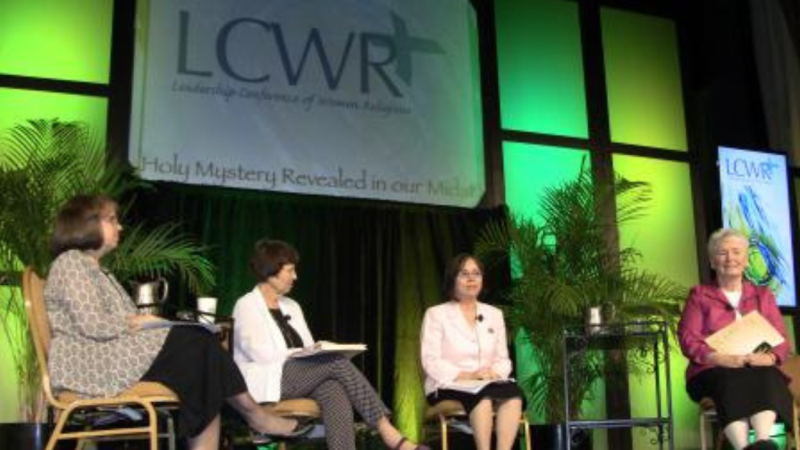
It’s time we sisters put out our OWN movie. It could be a group of 5 minute vignettes on actual sisters doing actual ministry, perhaps linked together with some sort of “Nun Con” like the LCWR annual gathering tackling some issue (Last year it was on global climate change http://www.lcwr.org/lcwrannualassembly/2008%20CMSM-LCWR%20Joint%20Resolution%20Press%20Release.pdf )
We also need to get better coverage of the Women and Spirit exhibit traveling in the US now. http://womenandspirit.org/specs.html
My two cents.
Father Martin has written a wonderful article, and I would expect Mr. Rudnick, when he becomes aware of it, to acknowledge many of the points.
Father Martin’s recitation of remarkable contemporary sisters and nuns (“Sisters who for many years made almost nothing, took very little and gave everything.”) is helpful in countering the deleterious stereotypes.
It’s interesting that the finished product, the movie Sister Act, has been listed as a favorite by several bloggers for its depiction of nuns.
Best regards to all-
There are a number of videos highlighting the lives and efforts of contemporary sisters on some sisters’ websites including these from “thedigitalnun.com” …
See “sisterpod” : http://vodpod.com/cdpjudith
We can also “push” for Congress to pass the resolution honoring the contributions of US sisters:
http://www.govtrack.us/congress/billtext.xpd?bill=hr111-441
Best to all (and now I really have to discipline myself and get back to my job).
Religious sisters get a bad wrap. To be direct, it sucks, too. These woman have given their lives to educating, nursing and advocating for generations of people–some of whom aren’t the slightest bit thankful. Here is a short list of things I’ve learned from nuns:
1. almost everything I know about literature
2. the lion’s share of what I know about theology and Church history
3. how to speak Latin–not much call for it, but I can do it
4. how to look adversity in the face and say, “Get the hell out of my way. I’m doing God’s work.”
5. how to be a better person
6. how to love my enemy
7. the Will of God ain’t always easy
8. stand up for yourself
9. stand up for all those people and animals and bits of nature that can’t talk (all my teachers were Franciscans)
9.5 brown and black to go together–if you’re a Franciscan
10. God loves you the way you are, but there is always room for improvement
Nuns are some of the movers and shakers at the forefront of many current and pressing issues. They always have been. Nuns are the work horse of the Catholic Church. For all of us who went to Catholic school, we can thank St. Elizebeth Ann Seaton and her sisters for that. Let’s not forget the tireless work sisters gave and still give to health care. I’m proud to say I’ve never been treated at a hospital that wasn’t owned and run by an order of sisters. Sisters are branching out, too. They are tackling social injustice, climate change, and a host of other things. These works aren’t being proclaimed loudly in the media because they are too busy making things happen to take the time to call a press conference and talk about it. They are doing…not talking.
Furthermore, doing the Lord’s work is what’s important, not getting credit for it.
Like Father Martin, I am a fan of the New Yorker, especially, and generally enjoy Paul Rudnick.
I have only read the abstract and Fr Martin’s response (and one other Catholic media response online yesterday). It seems that this was a clumsy, hurtful, unnecessary piece, and maybe Rudnick’s views are why the movie was eventually taken away from him. I am surprised that the New Yorker published it with the harsh comments on nuns intact, and will be interested to see if there is an editor’s response to the letters to the editor I would anticipate will arrive.
I do not know how to articulate this well but will try, with apologies. The correction I desire is different from those others suggest. It bothers me when this kind of thing is countered with praise of nuns, with litanies of all their selfless acts, etc. Is the harshness only a problem because these are good women? Or is the harshness a problem because it is harshness toward another human being, another child of God? What will we say when a person of whom we know no good is called a “chimp”? How will we respond to the rejection and debasement of an Other whose worth is unknown, invisible or overtly absent to our human eyes?
Ugliness about nuns is unacceptable because they are human beings doing their best.
And not, in my view, for any other reason. All glory goes to God, right?
Father Martin’s enumeration of specific nuns that contradict specific “Rudnick stereotypes” and his concluding statements in which he objects to the use of dehumanizing language about any group of people (nuns included) nails it for me.
His point did not require the intervening paragraphs that lionize nuns. And a lionizing of nuns as counter-argument against attacking and humiliating them misses, it seems to me, the raison d’etre of nuns.
Jean
I’ve not read the referenced articles yet (will do so later) but I felt inspired to share my view on nuns. I’m a lay householder, a convert of eight years, and I’ve known several Benedictine brothers but few nuns. (After reading Jack’s list above I particularly regret that). But I do read this and other nun blogs because I believe they inspire and guide me on my spiritual journey. I feel very blessed to have access to these blogs. I’m impressed by how thoughtful, intelligent and Gospel-oriented nuns are, based on reading the entries and comments. Even if those of you who post are not representative of the population, you all give up much to serve others with little or no recognition (as has been mentioned above) and don’t deserve to be harshly insulted or lampooned. I respect and appreciate you all, and this blog is a breath of fresh air.
Addendum:
Someone responded to Father Martin with this: “Here’s a really radical idea: If you want people to treat nuns with respect, you could try treating them with respect yourselves.” She directed her comment specifically to priests (and I am aware of one blogger-priest who is contributing and hosting vitriol against nuns), and goes on
to ask “how many nuns were present when the Pope was elected? That’s right, ZERO. Sure seems like priests don’t have a whole lot of respect for nuns either”.
Her question implies a larger one for me, which may be rhetorical in style but I am genuinely asking. In referencing the Vatican Visitation and doctrinal investigation upcoming and to the genuine angst being experienced by many American Catholic sisters and further stating that this context makes it a tough time for nuns to be roughed up, is Father Martin asking the non-Catholic world to enter into our internal relationship and conflicts? If so, is that helpful? Might it be counterproductive? Is it appropriate? Does it serve the very fundamental role of Gospel evangelization?
My father is in mid70s, lifelong Catholic, deputy grand knight for his KC chapter, in transition from being a “fiscal conservative and social liberal” to being strict adherent to all the Church’s teachings, which he acknowledges does very seriously complicate his voting in a new way: how is he to vote “Pro-Life” when anti-abortion candidates are often pro-death penalty; often pro-war without reference to even “Just War” theory; often pro policies that put our natural world as well as the longterm survival of Life at risk; often engaged in decision-making that pits profit against poor people?
I admire this very Catholic struggle deeply, but then there are these days: he was wound up the other day because of the memorials to Michael Jackson about which he said, over and over again, as he whipped repeatedly through the family room where several family members were watching the memorial: “They didn’t make this big a fuss when the Pope died!” I took several deep breaths and said, “Dad, most people are not Catholic”. I know his distress comes from a deep belief that the Pope is everyone’s Holy Father, whether they claim him or not. But we Catholics don’t get to mandate that our concerns become everyone else’s concerns, just as no other faith gets to mandate that.
And, though that story may be “smaller” than this issue about Rudnick’s New Yorker piece and Father Martin’s response, it is along that vein that I am uncomfortable that Father Martin says in the middle of his piece, in essence, “hey, you non-Catholics the nuns are getting some pressure from their own hierarchy here so back off, please”.
Again, Father concludes with the primary reason not to call sisters “chimps” is the same reason it is wrong to call anyone a “chimp”: it is dehumanizing.
That some believe the Church has a tendency to disregard contemporary contributions of nuns (that’s my hit, too) does not, for me, create the need to demand regard from non-Catholics as a counterbalance to the Church’s disregard, no matter how much people may have benefitted from the work of nuns. I detect a leap from “the Church needs to do much, much better” to “because the Church is not, the rest of the world needs to” and I think it does not help (in addition to the concerns I expressed in my previous post).
I wish Father had stuck with his main point and not shored up his request that all readers take into account – in monitoring their own language for dehumanizing and vitriolic speech – a conflict entirely internal to the Catholic community.
Jean
Last, I promise (for today anyway):
At USCCB, Sister Mary Ann Walsh has posted a response that I think is a bang-up job and is consistent with Father Martin’s main concern.
And I do appreciate that Father Martin supports and honors his Catholic sisters. Am just questioning its efficacy in this context.
Jean
Was wondering if you’d seen that article. While I’ve never met anyone from Regina Laudis, I’ve met a few sisters from a community formed from them, and they’re an awesome group of people.
That having been said, I wonder if some of the vitriol spewed both at habited women religious and those who don’t wear habits isn’t a sign of something larger. In both situations–the fetishizing of nuns in habits, and the denouncement of religious who don’t wear habits–is a result of women’s work and talents not being valued or recognized. In either case, women are objectified and not seen as people.
Father Martin’s article is great. He hits the nail on the head. I especially like when he mentions noone would get away with calling a rabbi dictatorial or a Muslim woman a bat. That is SO true. What gives here?
Well, Catholics are indeed often targets. But even moreso, so are women. So you find someone who is Catholic and a female, it’s like paydirt! As a Catholic woman, it infuriates me.
Could Father Martin perhaps send his article into The New Yorker as an editorial? Would they print it? That would be the best thing!
dee
P.S. I know it’s not generally their style, but perhaps a few lawsuits, not fatwas, but lawsuits on behalf of the sisters would keep people in check about mocking them. Could even get the ACLU into the picture. That would be interesting. In some ways, it’s a matter of justice. dee
As an aside, the history of Regina Laudis and her foundress, Mother Benedict Duss, is extremely interesting. From her promise to Our Lord in a French abbey under siege during WWII to her trek to America to fulfill that promise can be found in a wonderfully interesting read.
http://www.abbeyofreginalaudis.com/catalog/index.php
For those of you who might want to learn more. . .
Jen – I agree with you that beneath these stereotypes about nuns are is some ongoing misogyny at the level of society and culture. It’s as if some part of the culture is still trying to wrap its subconscious mind around the idea that, for many, many women (nuns included), that old slogan “A woman without a man is like a fish without a bicycle” is true. And that a woman without a man can be utterly and productively healthy in her sexuality, her psychology, her spirituality, her politics.
Nathalie once said here that some people can’t imagine that nuns aren’t “bungled” in some way; and the only way to account for the life of a nun is to uncover the ways and degrees to which that woman is messed up. In my mind, that is most symptomatic of the misogyny of which you speak.
Hey Dee – The form of “justice” the ACLU protects is freedom of speech that does not fit the legal definition of “hate speech”, which is hate that rises to the level of or incites/creates physical violence (my summary of the law). I know how much you love nuns and the close relationships you have with them through your incredibly active lay life but this is not an issue that can be litigated in any way. This is hateful language, not “hate speech” and – short of hate speech and other legally prohibited forms (defamation of character, libel) – our language only changes through practice and dialogue. I really do respect your loyalty to nuns, Dee, and you. It’s just that I can just imagine the wild satire that would result from a legal pursuit of Rudnick; the New Yorker’s humor columnists and their “About Town” essayists would never run out of pretty funny material and “fatwa” would be all over it. I can see Rudnick, Letterman, Leno, Conan, etc., going bananas with the fun of protest that even smacked of censorious protest about this.
I second you in that I would love to see Father Martin’s blog post in the New Yorker as a letter to the editor (though, as I said, I hope he would edit out the stuff about the Visitation and doctrinal investigation). I would especially like to see Sister Mary Ann Walsh’s blog post there.
Jean
Jean and others:
I feel one of the reasons these other groups do not get the same type of negative treatment as sisters do is because they “fight” back. Let’s face it, the squeaky wheel gets the grease. And, on occassion, this has led to legal action. Sometimes protest works best when it hits people in the pocketbook. That was my point. I’d like to add that some of the comments made about nuns do border on defamation of character.
Now I don’t seriously expect or suggest that sisters go to court on any of this. It’s not my decision or business anyway. But if it were, I wouldn’t let the likes of those comedians out there stop me. Not sure Conan O’Brien would chime in. I’ve heard he is a devout Catholic. But who knows?
Finally, I do believe there is some misogyny behind all of this. In spite of the progress women have made in this country, there is still plenty of predjudice out there. This hit home to me especially when I saw how the media handled Hilary Clinton during her candidacy for the presidency. I’d like to mention that I don’t see sisters only as female religious, I also view them specifically as women. Therefore, I see mockery/misrepresentation of them not only as a religious issue, but also as a womens’ issue.
dee
Friend Dee – Thanks for clarifying. My thought re: the comedians having a heyday with certain kinds of responses is along the lines of “choosing our battles – and our spotlights – well”. At any rate, I love the tactics of the Sister RP and the questions with which Sister Julie concludes today’s post. Jean
Regina Laudis; yes Hollywood Hart connection, prototype for “Come to the Stable” film of Loretta Young ! fame and all that. BUT did not the author choose well for what he wanted to examine? RJ has to be one of the most hoe the line Benedictine convents in the land. Of course he would find there the stereotypical things; customs
out of kilter with the general and current usual convent culture. Current convent culture eschews wearing the religious habit and community prayer among other things. These are things RL is known for.
. What could you expect?
Dave and others:
I don’t know how many congregations wear the habit and how many don’t. My guess would be more don’t wear the habit than do. The ones who do, however, seem to be pleased about it from what I’ve seen.
I suppose some congregations have weakened on communal prayer. But all Benedictine houses, purely comtemplative or not, still do communal prayer, i.e., the Liturgy of the Hours, Divine Office or Opus Dei as it is called, at least 3x a day and many do it more. From my admittedly limited experience, most apostolic sisters who live in community still do community prayer at least once or twice a day. Some may not. I certainly can’t speak for all.
From what I’ve heard, Regina Laudis is really very unique for the United States. They are certainly very traditional as well not just because of the habit and the frequent recitation of the Hours, but because they chant them all in Latin. As you may also know, they work at a number of the traditional monastic arts too.
dee
dee,
Remember I didn’t say Benedictine houses did not pray communally.
I am well acxquainted with them and with Trappestines. But, as you
say the Regina Laudis Benedictines are unique. Ergo, he chose them.
The description of Regina Laudis you gave is why Rudnick chose it
as I stated. What is the the fun of visiting the other kind of sisters who
apparently form the majority these days?
Regards,
Dave
I like to read what I criticize; my New Yorker arrived Friday and I did
actually read the item. That was a pasticle of memories of 20 or more
years ago to do with his connection to “Sister Act”, the film. And the
visit to a nunnery was tacked on as part of his dopey “search” for
something. He knew nothing of the convent he chose; Regina Laudis
is one of the most conservative, strictest Benedictine houses on the
continent. Come on, Rudnick. What is not to satirize for a person
like him? The gift shop? the chapel? That appears to be the only places he saw or cared to write about. Ridiculous. Consider the source as we used to say in my youth. And forget about it all you that do shout.
Dave V – I just read the entire piece, too, and my assessment of it: it is problematic AND I think it is just plain trash, a prolonged bit of industry gossip with no redeeming value beyond the cheap and tacky laughs. The worst of the comments widely quoted elsewhere were, I think, taken slightly out of context but they were still tacky and, in that, inconsistent with The New Yorker’s “usual”. I love Vanity Fair: a lot of it is what I call it “trash, but well-written trash”. Rudnick’s piece was too trashy and tacky even for the position of Vanity Fair’s “tackiest article”. I can’t help but wonder if it as a “throwaway” piece in Rudnick’s or The New Yorker’s files and they decided to run with it because nuns are “topical” this summer. Having read its tacky, trashy self, I imagine that most New Yorker readers were more than unimpressed, if not uncomfortable. Jean
I haven’t read Rudnick’s article or Martin’s response, but I do know the sisters of the Abbey of Regina Laudis, and they are the furthest thing from repressed, unhealthy, grumpy, unhappy or any other negative image that’s been used to describe them and other women religious – either cloistered or apostolic.
I’ve been in a religious community for nearly 25 years, and through one of the most challenging periods of my religious life the wisdom, hospitality and the profound presence of the nuns of Regina Laudis not only nurtured my vocation as an apostolic religious, but in many ways, I believe, saved it.
Their unabashed claiming and living out of their cloistered, monastic religious identity freed me and others of my sisters to more freely and more profoundly claim our identity as non-cloistered, apostolic women religious.
My and my sisters’ relationship with the nuns of Regina Laudis is a grace and gift to all of us as we support one another in the embrace and full flourishing of our respective expressions of religious life, both of which are rooted in the Gospel, confirmed by the Church and needed by the world.