Wondering how God is calling you? Are you curious about how your job or set of relationships is really a vocation? Do you want some awesome discussions around faith in real-life and more? Think hanging out with Catholic sisters and a fun thoughtful, faith community is cool? Then you are in the right place! Welcome! Explore and be sure to visit with us every weekday at 6 pm CT in our chat room.
Sister Sandra Schneiders on U.S. Women Religious and the Apostolic Visitation
Sister Sandra Schneiders’ essay on U.S. Women Religious and the Apostolic Visitation is a must-read essay for all Catholics, all people interested in Catholic sisters and nuns and/or in U.S. history, and definitely all those discerning religious life.
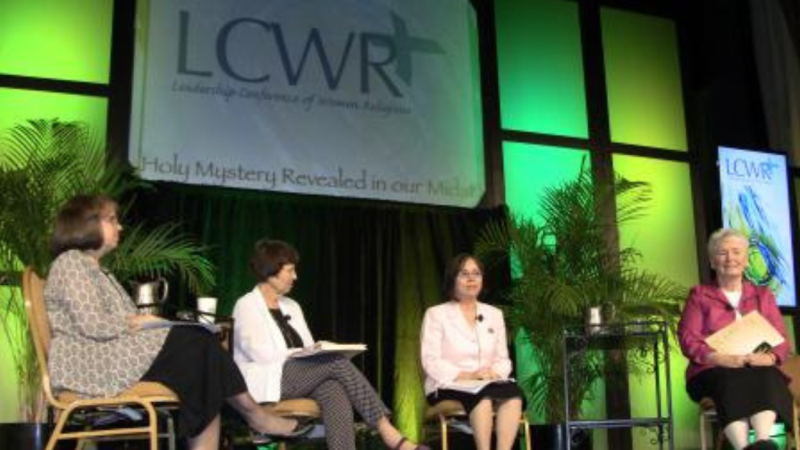
The National Catholic Reporter has just published an essay by Sister Sandra Sandra Schneiders, IHM, called Why They Stay(ed) (NCR, August 17, 2009). The essay addresses two sets of questions concerning U.S. women religious that are “roiling the waters” in and outside the church today:
- Why are religious disturbed about the apostolic visitation?
- What is the real motivation for this investigation?
What follows is the most lucid discussions on the topic of the Visitation that I’ve encountered. Not only does Sister Sandra address how the Apostolic Visitation is being received by many U.S. sisters and nuns as well as many priests, men religious, and lay people and why it’s disturbing, but she explains what the situation of women religious is and has been since around the Second Vatican Council.
I have to re-read the essay and will offer more thoughts. For now just want to make sure you have seen it. Please bring your questions, comments, and thoughts about this to the comment section below.
Previous post: FP001 Feature Podcast – NRVC Vocations Study
Next post: A Nun’s Life podcast updates


Get your nun schwag! -- We've got cool nunly items including this awesome mug at 
{ 32 comments }
I respect Sr Sandra very much as my sister in Christ. I’m afraid that even after reading her essay I still don’t understand her point, though. My basic question: if the sisters aren’t doing anything wrong, why do they care so much about the visitation? And I know part of her answer was that it was the principle of the thing that was so insulting (at least that’s how I read it) — but I’m afraid I don’t understand that either.
Could someone help me with this??
I would hope that the Vatican and American sisters would be united by love in actions as they are in mission. Sometimes humble obedience is the only way to go when you disagree so vehemently with someone…especially when that ‘someone’ is part of an institution that goes back nearly 2000 years!
Again, all respect intended here and I really do just want to understand this.
“Kizito”
Hi Kizito, Thank you for writing and for speaking charitably about your disagreement. I can’t speak for Sister Sandra, but I can give you my thoughts.
I think there are much deeper issues at stake here than “simply” feeling offended. My reading of Sister Sandra on this is that she, and many others, are concerned about the life of the Church and religious life, particularly here in the US. The fact is that there are real consequences to this Visitation regardless of the findings. Even the announcement of the Visitation was enough to pit Catholics — with encouragement from the media — one against the another around what a nun should be like, who’s dying out, who’s faithful, and who’s not. The fact of the Visitation has affected how some people view women religious and there’s a good chance it affects people’s inclination to check out a vocation to religious life. If the Vatican is conducting an investigation on an organization then it doesn’t really give possible new members a good vibe about joining that organization.
The implication that women religious have done wrong on a large, systematic scale is not exactly something that I think women religious can just brush aside. It takes not only a lot of guts to respectfully respond to the Apostolic Visitation but it takes an awful lot of humility and prayerful discernment. While I can’t speak for Sister Sandra, I can tell you that she’s got both humility and a discerning spirit. In my humble reading of her work, she’s speaking up not so much for herself but for the thousands of women religious who have given their lives and their deaths to God, the Church and the world. Her words are encouragement and balm to those of us (not just religious) who feel so conflicted about how the Church we love could possibly put us in this situation. “Humble obedience”? I think that’s exactly what Sister is doing. She has not said “don’t cooperate”, “ignore the findings”, or “sabotage the process”. Not at all. She like every other good religious, regardless of their concerns about the investigation, are cooperating and, in Sister Sandra’s words, are hopeful that “the present investigation will make evident to those whose concerns gave rise to it the meaning of religious life as it is being envisioned, lived, and handed on today in Congregations renewed in and by that Pentecostal outpouring of the Spirit called the Second Vatican Council.”
I don’t know that I’ve helped at all with clarity, Kizito, but maybe just added another voice to the mix. It’s a difficult, complex situation. I think you raise a good point that in this we must tap into the common love and mission that we share and keep that at the forefront. That should characterize all of our reflections and actions even when we must humbly disagree.
I have read Sandra’s article and agree that her explanation of the visitation–and the concern surrounding it–is indees a lucid and honest account. I am particularly drawn to her closing segment on why “those who stayed, stayed.” I professed my first vows in 1962, rejoiced with Vatican II, lived through the tumult, ached with the loss of the wonderful women who chose to move out of religious life. As Sandra said, so many of those women remain connected with our congregation today and continue to live out, in other ways, the charism they shared with us. I stay because, in spite of the struggle and in spite of my own longing for a change that I wanted to happen faster than it was happening, I knew deep down inside me that this was where God was calling me to be. And that calling is still there. I love my community and I’m proud of who we have been, who we are, and who we will be. Any concerns I have about the visitation come, not out of concerns about what we are doing but out of concerns about the misinterpretation or misunderstanding of who we are, concerns about being “evaluated” or “rated” by structures or instruments that somehow miss the whole concept of who we are as Franciscan evangelical women.
Hi Sister Ann Marie, I too found that last part fascinating. I was aware of what happened (wasn’t born till after Vatican II) but never really thought about it the way she described. I love what you wrote, “I knew deep down inside me that this was where God was calling me to be. And that calling is still there. I love my community and I’m proud of who we have been, who we are, and who we will be.” That makes me proud too.
Sr Julie,
Thank you so much…I think I am starting to understand Sr Sandra’s position better, and yours too. I really do want to understand and I am sorry if I offended you or anyone else in my original comment.
I think I get what you are saying, though. I don’t agree completely, but I understand and that’s what I was aiming for
)
Thanks again!!
“Kizito”
Kizito, I am glad you wrote. It gives me a chance personally to think about this from different perspectives. And you did not offend me at all. In fact I appreciate that you asked and shared your thoughts with grace. Blessings, Kizito.
I think some of what you’re saying, Ann Marie and Julie, was also said in the great podcast yesterday. To have a calling to religious life is just the first step– then you have to figure out which community God is calling you to, and there are so many! To cast a shadow over all communities through the apostolic visitation is a blow to the vocations effort that Sisters are so involved in. It is sometimes difficult to have hope in the future and move forward with the vague criticism and lack of transparency of the whole investigation. I have read the document sent out for reflection that was attached to an article in the NCR, and it is still not clear to me where this thing is going. I work with Sisters in trying to move their ministries forward and plan for the future, and though I am quite certain the community is not doing anything wrong, there is still an uncertainty to planning because we have no idea what will come of this blanket and pretty undefined investigation.
Dear Sister Julie, Sister Ann Marie and Kizito,
This is one of the first times I have read an exchange about these issues that has not left my nerves jangled by hyperbole, negative characterizations of others, name-calling (toward sisters, Vatican, lay people, pretty much anyone and everyone), a pitting of one kind of sister against another.
What a relief.
I am one of those who went through weeks and weeks of concern that US religious life was no longer a viable option for anyone seeking to live a life focused on Jesus and his ministry in all its forms. The reactivity of the responses that followed the announcement of the visitation and investigation seemed as far from the life of Jesus, even during the Agony of the Garden, even when he faced certain torture and Crucifixion. I was sick to my stomach that I was feeling called back and more deeply into the Catholic Church at a time when its central meaning seemed so utterly lost on its members and communities
I had not, Sister Julie, considered whether the way the visitation and investigation were announced, etc., have contributed significantly to the tone and energy of responses from persons in all corners of this debate. Now that you have pointed that out, the handling of the initiative does seem unfortunate and counterproductive.
Nonetheless, it is respectful and peaceful exchanges and disagreements like the one above that restore my faith that Catholic religious life is a viable context for U.S. women who are called to consecrate their energy, their love, their lives and – as you said Sister Julie – their deaths to Jesus and his ministry.
Thank you, Kitizo and Sisters. Jean
Thank you Sister Julie for posting Sister Sandra’s essay.
To be honest I try to avoid talking about the Apostolic Visitation simply because it leaves me with a uneasy feeling and ultimately: frustration. I sensed from the very beginning that this wasn’t just the Vatican checking up on US congregations. As Sr. Sandra stated “Religious congregations are in regular dialogue with church authority.” So why this “visitation”?
That question has probably frustrated me the most and I know I’m not alone. If the Vatican thought US Congregations were doing “a great job” why the need for a “visitation”? I know no one can really answer that question again, frustrating.
There is also a very real fear about the outcome of this visitation. Will orders that I’m interested in be shut down will they change? Again no one can answer that. As someone who has been discerning for barely a year this has made a difficult discernment even more difficult. Common sense tells me to run away from this while I haven’t made a commitment. It tells me that an organization that I want to give my life to may change radically by the time I graduate college and furthering my discernment will only leave me hurt and confussed.
Yes this has tested me as well as my fellow discerners. I can’t talk for them but for some reason this has only made Religious life more attractive to me. I get to see it’s true colors and it’s unwavering dedication to the life they choose and for some reason I like Religious life even more.
I applaud Sr. Sandra for writting this essay. I loved the conclusion especially this statement: “…given the enormity of the challenges they confront — must be rooted in something, Someone, much deeper and more central to their lives than anything temporal or material.” Could not find anymore of a truer statement.
Audra –
I share your increased attraction to Religious Life as a consequence of this series of events (now that I am over the sick-to-my-stomach-and-pissed-at-God part of this).
As this whole thing unfolded and after I read exchange after exchange in which people alternately feared or hoped that the sky would crash down around women religious of various stripes, I started asking vocation directors – almost first thing – about how they were coping with these events. Almost to a one, the sisters I questioned responded with confidence, ease and an expectation that, if there was something to be learned – some way in which they as a community and corporate body violated their canonically approved Constitutions, etc. – they would address those concerns and move forward. Had any relayed to me an anxiety that sounded immune to the calming and humbling and hopeful influence of prayer – had any order sounded distracted from their ministries and contempative prayer lives by the pending storm – I would have had compassion for these human sufferers, and I would have moved on, for good. That the sisters I spoke with remained focused on their ministries and prayer lives was very exciting to me. Whatever the truth of the visitation and investigation turn out to be, in the end, the sisters showed me that “the proof is indeed in the pudding” of their continued “faith, charity and hope” even in this very hard time when they fear for their own futures. To live a such a life – a life in which human anxiety and fear are answered through service and prayer – once again became attractive to me, too.
Jean
Sisters – thank you. I am a New Zealand Anglican – so removed both physically and in a different Church tradition from yourselves, but also a member of a religious Order and deeply committed to the religious life in all its forms. I have been praying for you all during this whole process, that out of the struggle will come light, out of the pain, joy. One of the things I’ve been reflecting on a lot lately is the incarnation: Jesus our God coming to us through pain, darkness, suffering of a woman. Maybe the Visitation offers another way to incarnate God to those you minister to? You certainly do to this Kiwi, away on the other side of the world.
May God bless you all.
Robyn
It has been refreshing to read comments in which participants respectfully question one another and disagree. I have been disturbed by so many of these chats that seem to repeat talking points and ooze vitriol. They mirror the kind of hate-filled debate we are finding on TV and political life. I think most sisters think seriously about any call to renewal. In my opinion, setting up investigations, given their nature and the smear effected by the simple institution of them, was not an effective way of doing this. In the long history of the church, the Vatican has not intervened in this way in the life of women’s congregations. The move is extremely “untraditional. It has been justified by some as the result of declining numbers, but the reasons are much more complex.
My two cents.
As to the Apostolic Visitation, I say bring it on! Rome will get a an idea of what workhorses we are, how we have had to do so much with so very little, how we are good stewards and how well we live out the Gospel.
Bring it on!
I think that after the LCWR leadership has been spewing statements like this for years:
“The dynamic option for Religious Life, which I am calling, Sojourning, is much more difficult to discuss, since it involves moving beyond the Church, even beyond Jesus. A sojourning congregation is no longer ecclesiastical.”
It’s rather disingenuous that she claims to be dumbfounded by the reasons for the visitation. After all, is the LCWR leadership Christian and Catholic or not? Statements like the one above doesn’t sound like either or the result from any fruitful dialog with the Church, which they always seem to treat as the “other”, not “us”.
Dear Robyn –
Your post is beautiful in paradoxical hope, especially in these words: “I have been praying for you all during this whole process, that out of the struggle will come light, out of the pain, joy. One of the things I’ve been reflecting on a lot lately is the incarnation: Jesus our God coming to us through pain, darkness, suffering of a woman.”
With God, with a life in Jesus, there need be nothing of the victim, nothing of despair in our articulated responses to others, even if we fear we may come to harm as a consequence of those others’ intentions, words, actions. We can work for justice for all – including for ourselves – while still walking with in the peace and love of Christ, while looking for (as you said so beautifully, Robyn) “Jesus our God coming to us through pain, darkness, suffering of a woman”.
Part of the magnificant generosity of Jesus, for me is that he never failed to teach us, through his own living out of God’s call to him, how we could live our lives. We know how to live “the madness of the cross”: Jesus showed us and we can choose his way: continue to speak the truth while striving to use every moment to express love and charity toward all, in hopes that the ninety-nine will go on evangelizing the one. We just need to choose Jesus’ way of living the cross.
Robyn, you are one more Woman Religious whose spirit thrills me and comforts me by deepening my prayer and understanding of how *I* might live through own pains, darknesses, suffferings. Thank you.
Jean
Jean
Hey Augustine –
The quote that you mention did not come from the LCWR leadership. It comes from a paper by a Biblical scholar named Sister Laurie Brink.
Have you read the whole paper? That paragraph *is* rivetting when taken out of the context of the 26 or so pages that surround it.
Once I read the whole paper, other paragraghs stood out for me and I saw that that widely-quoted paragraph had an entirely different meaning than the one most often cited. Sister Laurie asks her larger community very difficult, very challenging questions….which is a scholar’s job and she did it thoroughly.
I have new respect for the LCWR leadership that they invited her and her fearless scholar’s mind and mouth —– she is not a yes-woman for her life as a Woman Religious, and that her paper has been posted in its entirety on the LCWR website.
Peace, Augustine. Jean
Jean,
I did read the paper and I think that that quote is not out of context, but is the apex of the gist of the paper: post-Christian, syncretist, feminist, pan-sexual, etc. In a word, heretic. At least she herself acknowledges that that does not attract vocations, blessed be God!
Quite telling about the state of the leadership of the LCWR… So. there, they shouldn’t pretend to be surprised at this visitation, except for its tardiness.
Augustine – I am glad you read it and could find some point of agreement with Sister Laurie. I find dialogue pretty challenging when there is no agreement on anything! I think we have to stick with it but I do find it exhausting. I actually think Sister Laurie made some assertions that are far more challenging than that some developments are unattractive to potential discerners.
By the end of the article, my attention had become focused on the autonomous and pro-active developmental process Sister Laurie proposed and explored as it was already being practiced by some orders. I was interested in her “typology”, if you will, and respected both her challenging questions and her attempt to refrain from an authorative future directive to any order of any “type”.
Twenty years in the work world and academic life as a student have conditioned me to expect secular “visitations” in the form of organizational reviews, evaluations, recertifications, etc. They are almost uniformly miserable experiences because adults hate to be evaluated. I think it challenges our sense of autonomy and competence as adults and I think that is a perfectly normal and healthy response, albeit one we in need to manage and move past or, at least in the secular world, we may find ourselves without a job (if the objection is individual) or organizational member (if the objection is corporate). Organizational leadership is often wildly ham-fisted in review initiatives and it always disappoints and angers me. All too often, these reviews are pro-forma, in that a plan for change is already in development and the review shaped (consciously or not; we humans are such complicated mysteries, even to ourselves) to support the direction the leadership is preparing to move. Again, disappointing and maddening. But common. I know that these experiences in secular
organizational life are shaping my response to the Visitation and investigation. I just cannot get that excited any more about the fact of reviews as an event in organizational life. I am not at all surprised that such processes should occur in ANY organizational setting.
What I do think is wonderful about Sr Laurie’s paper is that can be seen as an attempt to empower all Religious Women. She is saying to her sisters, “let’s take a look at ourselves and envision our future vis-a-vis who we are today”. As a scholar, she advocates implicitly that “the look” be edited for the human distortion of what we WISH to believe is factual versus what IS factual. That is a challenge that is routinely painful and time-consuming for most humans and organizations. And it is a profoundly liberating and empowering challenge.
Sister Laurie was, I think, writing both with deeply generous intentions and the intellectual honesty required of scholars.
That I believe she was being “intellectually honest” does not mean I believe Sr Laurie’s are “the last words needed”; only that I believe she spoke the truth as it sounds to **her** in the harsh light of the middle of the night, when all the editorial noise and the passionate desires and self-interested needs of our lives and the world quiets down.
Nice to talk with you, Augustine. Peace
Jean
Jean and Augustine,
The article by Sr. Laurie sounds interesting but I cannot seem to find it on the LCWR website. Could someone please post a link?
Thank-You, Sarah
Sarah –
Go to http://www.lcwr.org/lcwrannualassembly/2007assembly/Keynote.pdf
Jean
Sister Julie and all,
I just finished reading “Why they stayed” for a second time. I trusted, both on an intellectual and emotional level, the second half of the article. It was a beautiful and informative discussion that makes me eager to read anything and everything I can find by Sr Sandra.
That said, I wish she had remained focused, as she did in that second half, on the material that speaks to her title.
The first half seemed an entirey different article. I would venture that, whereas the second half struck me as a history based on research and experience, the first half struck me as an op-ed piece. I had a difficult time intellectually with the legal analogy, though I certainly see its persuasive value in argument. I recognize that my knowledge of Church history, Visitations and the actual and applied meanings of what it means for an order of religious to have a “canonical” relationship with the Roman Catholich Church and the Vatican. Thus, it is possible that greater knowledge in those areas would render, for me, the legal analogy more applicable to this circumstance, but I am experiencing a fundamental (though elusive) cognitive dissonance that causes me to maintain my doubt on the appropriateness of that analogy. I simply believe, with all due respect to Sr/Dr Sandra that this is a false analogy. A powerful one but a false one.
My hit is that the first half of the article is unfortunate and will not be persuasive for those that Sr Sandra and others most likely seek to persuade: those actually involved in the Visitation process.
I am deeply grateful for the second half and Sr Sandra’s deep commitment to her life as a Religious and as a Scholar.
Jean
Augustine, please re-read Sister Laurie’s talk in its entirety, and take note of Jean’s reflection here (and others). Sister Laurie was discussing four visions of religious life that she had observed–she was NOT endorsing any of them, nor was she suggesting that the one you cite was representative of her, her community, or even any significant percentage of sisters today.
My mission unit (small group) within the IHMs (I am an Associate member of Sister Julie Vieira’s community) discussed Sr. Laurie’s talk when it was placed online, and most of us had one of two reactions: 1. Either we thought that NONE of the “types” of attitudes toward religious life was, taken alone, descriptive of their beliefs and experience; 2. The one you quoted was an extreme position that might reflect what some actual sisters believe–but not anyone in our group (or more than a couple of isolated individuals that anyone in the group had ever met).
Augustine, I don’t know why anyone would enter or stay in religious life today if they were totally “post-Christian”–it would be like staying in a marriage if one didn’t believe in the legitimacy of that institution. I have met sisters in literally hundreds of communities (I am a scholar who studies nuns), and am blown away by the devotion, faith, and witness of virtually all of them. These are not just “progressive” communities; I have visited a number affiliated with CMSWR, as well as several LCWR-affiliated congregations whose members wear habits and live what might be described as a more conservative form of religious life.
I am grateful to Sr. Julie for providing a place where those of diverse perspectives can discuss matters with open minds and where we all, I would hope, are open to learning from the perspectives and insights of others.
I just read Sr. Laurie’s paper and found it to be an excellent piece of work – thank you Jean for posting the link. I agree that she is writing about four options as she sees them, not an all-exhaustive list of possibilities or probabilities for the future of Women Religious. I thank her for her honesty and intelligence in presenting her viewpoints so clearly. I also read Sr. Sandra’s paper and found it to be a very passionate piece as well. I can understand the concern over the Visitation in light of the fact that I heard of no such similar Visitation when the sexual abuse allegations were pouring out against the Priests. Maybe I missed that thorough examination by the Vatican….? Anyway, all I can say as a Catholic lay-woman is that I was taught by Sisters of Mercy, Franciscan Sisters and IHM Sisters my entire life and still keep in close touch with some of them today. They are absolute inspirations in the way they live their lives and conduct themselves even in the most difficult of circumstances. For me, they are the face and heart of the church. I have known some wonderful Priests as well. But when I think of being a Catholic woman, it is in light of the numerous Catholic Women Religious who taught, reprimanded and loved me as I grew up, and who’s example lights the way ahead for me. It is not the Priests who lead me – it is my Sisters. Thank you all for your thoughtful dialog and respectful insights.
Thank you, Karen, for writing in. I have to go back and read Sister Laurie’s paper too. It’s unfortunate that one small piece of it got singled out and used as a womping stick against LCWR and member congregations. I so appreciate your words about the women religious in your life. Even though I wasn’t tuned into religious life when I was younger, I think back and remember how important they were to me, and then more so when I started pondering my faith and seeking something more in my life.
Augustine gave me a new word: syncretism. Thanks! It brings to mind a very interesting article I read in the June Sojourners, which you get in their online archives: “Christ and Whose Culture: A new wave of Native American evangelical theologians rejects the false choice between following Jesus or embracing their traditions”, by Kent Annan. It may not be at all interesting to you, Augustine, because it does not speak specifically to **Catholic** Christianity. But it was very interesting, especially in light of my new word (thanks again), to think about the generations of people of other belief systems who have responded in syncretistic (!) ways when they encountered Catholicism. I am absolutely talking from my elbow (and my knee) here, which I know you will recognize, Aug, but it has left me wondering whether some amount of syncretism might not be a means of “speaking of in [spiritual, mystical] tongues” to people from various cultures and belief systems. I recognize that I may be missing something about what constitutes genuine “syncretism” but I am just so struck by the reality that a substantial amount of evangelism must have occured over the centuries through that process. I am thinking even of St Paul and the adjustments he made, on Jesus’ behalf, to Jewish Christianity so that the Gentiles might be evangelized. Again, that might not count as formal” syncretism”, but I wonder if some of what you understand as heretical “syncretism” might be similar in inspiration and intention to St Paul’s adaptations of the “first” Christianity so that The Word might live for Gentiles as well and similar in inspiration when some missionaries to Native American communities see the Father, Son and the Holy Spirit in the Great Spirit and include prayer to and dance in celebration of the Great Spirit and, now, Native American spiritual leaders see the Great Spirit in God, Jesus Christ and the Holy Spirit and include Christian and Catholic Christian prayer ? Something for me to chew on when I get a bee in my bonnet about these issues, which I do sometimes. I love our Catholic theology, rituals and sacraments and, for me, personally, their richness is infinite and ever-unfolding and I do not need or want other theologies or rituals. But I am just Jean, an Irish Catholic American who, in this sense, am sort of like the “first” Christians (a “Jewish Christian”) and I am aware that the world is full of “Gentiles” whom Jesus might well be beckoning through these Pauline (“syncretic”) gestures toward other religious cultures.
Just a thought and a version of “use your new word in a sentence”… Thanks for indulging me; you all know I am never satisfied with one sentence when I can think of twenty!
******
One difference I can see between the sexual abuse scandal in the priesthood (and in the religious community) and the issues being addressed (at least those issues that have been publicly identified) is this. I expect that I am going to struggle to articulate this so please bear with me.
There is no evidence anywhere (that I know of) that suggests that sexual abuse became incorporated into congregational life, public ministry, congregational teachings and practices, ritual prayer, etc. There was never a suggestion that sexual abuse could be consistent with Chruch teachings. The secrecy and all aspects of the cover-up is a clear indicator that everyone, whether involed as perpetrator or silence-keeper, knew that the behavior was a violation of all that the Church stands for. The solution, then, is quite straightforward and exactly parallels that in secular life: do it, hide it, cover it up and your ass is going to county jail. (Sorry for the “a” word; plain old child protection street-talk). That process is underway and that reality is as real as it can get. Do it, hide it, cover it up and your ass is going to county jail, period. Spiritually, the response could – and I believe should – then continue as it always had: God forgives a contrite and humble heart and, when necessary, expects and demands reparation and deep, deep sacrifice and penance, perhaps for a lifetime.
I sincerely don’t see the need for an investigation in that instance. The investigation would be case by case, past and future and a strict monitoring and educational process. If an investigation had happened, all Women’s Religious communities would have been ***justly and necessarily*** investigated, because children have been abused by Women Religious, too. The fact that the numbers abused by sisters are very significantly less in this country than those abused by priests/brothers does not matter. One sister abusing one child, no matter the form or extent of abuse, is just as important a
accidentally hit “submit” before I was done….
One sister abusing one child, no matter the form or extent of abuse, is just as important as twenty priests/brothers abusing twenty children. Just ask the victims. (I do think this issue is another unfortunate part of Sister Sandra’s essay and several SNAP members and victims of sexual abuse by sisters have spoken out about her statement that seems to dismiss the importance of the smaller numbers of victims abused by sisters. I have absolute confidence that Sister Sandra did not intend to be dismissive or insensitive and, even, that she might not make her statement a second time).
The visitation and investigation of Women Religious, whether we like it or not, is clearly interested in what may have became incorporated into congregational life, public ministry, congregational teachings and practices, ritual prayer, etc.; what might be presented as consistent with Church teachings. There is, in response to this set of questions, no stunningly simple, straightforward, common sense “wheel already invented in the secular world” that can be imposed and implemented in this context.
Again, I know I have a high tolerance for this kind of thing from two decades of work in frequently-and-miserably reviewed environments and also from training/experience as a reseacher/evaluator. I am much more comfortable with participant-involvement in the design and implementation of research/evaluation AND I also have never seen it in practice except when I was part of the university team doing the research/evaluation (and, even then, let’s face it: power and control dynamics are tenacious!) So I am not surprised by this top-down thing. Disappointed, as I always am when leadership is ham-fisted but it is what I expect most of the time.
So, that’s my fifteen cents on why no investigation in one instance and why yes an investigation in another.
Jean
Sister Julie –
I agree with you that “it’s unfortunate that one small piece of [Sr Laurie's paper] got singled out”, misrepresented and was then used as a weapon. It also seems very “death-panelish” (to coin a phrase from another current brouhaha over a misrepresented paragraph).
It makes perfect sense to me that many Roman Catholics would express alarm if entire congregations of Roman Catholic sisters were to assume and declare a public, corporate and definitive “Post-Jesus” identity in their theologies and ministries. But that is not what Sister Laurie claims has occurred in fact (though she does name a single community she thinks may be tending in that general direction. I *did* wonder at her decision to make that identification and have wondered if she spoke with the specific foreknowledge of that community or if her language was, in fact, theirs, and I have hoped that one or the other is the case).
I am re-reading Sr Sandra’s article again to ferret out a better understanding why she used the legal metaphor. On third reading, I realized I am not troubled be her initial use of the legal language, when she speaks of Visitations as the ecclesiastical equivalent of a grand jury that bothers me and defines the conditions that (historically?) trigger such a visitation. That is all a matter of Church history – true or not – and I most definitely do not know Church history sufficiently to question.
What I question is Sr Sandra’s extension of the legal/grand jury analogy when she begins to, in effect, appeal to her readers to engage in a comparison of civil/secular processes and canonical/Church processes and, in that light, to consider what is appropriate in canonical settings vis-avis what is appropriate and customary and just in civil and non-canoncial settings.
****Quite obviously, when the conduct is criminal (physical/sexual assault/abuse; covering up these crimes; misappropriation or fraudulent use of funds, etc.) as well as a violation of Canon law and Church policy/processes, civil law and processes should be imposed and prevail and, in most cases, that will forcibly drive the ecclesiastical response.************
But when the issues are not criminal – sexual liaisons by those who have vowed celibacy; cult-like practices (assuming that criminal activity is not a component); other questions that fall exclusively in the province of the Church – I do not see how the legal/grand jury analogy is appropriate or applicable. Again, it is a powerful one and I see its value in persuasive argument, but I doubt its validity.
Can someone help me with this? I do understand that many sisters may *feel* that they are being hauled before a disciplinary board and, in the end, we may discover that this is the beginning of a disciplinary process. I am NOT discounting or dismissing that perception or “gut sense” and do, in fact, anticpate that some sisters and perhaps communities are in for some difficult months ahead, though perhaps more so from the LCWR doctrinal assessment than from this Visitation itself. And I would hope that all Women Religious would offer those sisters love and prayer and continued relationship – offers that do not require agreement on the issues – no matter the outcome.
What I am asking for here is help in understanding Sr Sandra’s legal analogy?
Thanks, Jean
Just to clarify:
I am not asking because I am determined to believe the analogy false or because I have “chosen sides”. I don’t think this is an issue in which “taking sides” will have any productive influence (despite the efforts being made on the internet to stir up a heated battle between sides). At this point, I simply cannot honestly say I accept the analogy as valid **********and*************I have long been concerned that this general characterization of the Visitation *is* resonating with a great many Catholics. (Sister Sandra is simply the most articulate person speaking in these terms but she is far from the only one. Just read the internet).
And I cannot take that resonance at “face value” and be influenced by it ….for the very same reason that I did not take at face value the deep resonance of the “death panel” interpretation of the healthcare bill as an indicator of the validity of that interpretation.
the energy of the masses is often sourced by soundbite and soundbite analysis (as we learned with that misleading soundbite
from Sister Laurie’s paper).
Jean
Hey – still hoping someone can help me understand. Obviously Sr Sandra did not write this lightly and, as a scholar, she is accustomed to rigorous debate about her writings and statements so I am hoping someone can help me understand. SiSter Julie, maybe you could pass my questions straight to her?
I am so completely turned off by the vast majority of discussions on this whole event (other places, not here) because the discussions tend to hinge on an affective logic (if positive regard for sisters, then Visitation is wrong and abusive; if negative, Visitation is right and not abusive). That kind of discussion makes me crazy (for me, it’s comparable to interviewing fans outside a football game…) and does nothing to further understanding and, certainly, does nothing to move people forward together. It does nothing to help those of who have positive regard for sisters but are still discerning whether we believe the Visitation is right or wrong, abusive or not (nor, for that matter, does it do anything to help those who have negative feelings about many sisters but are still struggling with those questions).
I have thought through whether this is one of those situations where it makes sense to say, “well, the people on the receiving end are saying it is wrong so I need to respect that as the truth of the thing: it is wrong and abusive”. I cannot articulate why I don’t think that applies here but I don’t think it does. That this is wrong and abusive IS one experiential truth of the thing but experiential truths are simply not the only ones involved in understanding organizational life.
It HAS occurrred to me that THAT is where my thinking may diverge from so many others on this. For me, the fact that this is spiritual life, Religious Life, life and self as total gift to God and God’s people CO-EXISTS with the fact that US Women Religious and their orders have canonical – and, thus, organizational and institutional- relationship with the organizational and institutional Church. And that relationship cannot be compared, in my mind, with that of a citizenry and its civil government (whether democratic or dictatorial) unless that organizational or institutional relationship is, in fact, philosophically and structurally defined in those terms. And, in the Roman Catholic Church, the case is neither, because it does variously use each structure, process or style. (Certainly its hierarchical structure tips it toward the dictatorial).
I am so sorry this is such a difficult experience for so many sisters and I do think that it has been handled in a ham-fisted way (for many of the reasons Sister Sandra notes in her essay) and it is painful for those who love and are deeply and appropriately grateful for the tremendous contributions of nuns.
But none of that helps me in understanding leaders and magnificent thinkers and women of God like Sister Sandra whose objections are not, I believe, affective in foundation and expression. (I like her so very, very much for not making a fuss about the leaked e-mail in which she shared her initial reactions and responses to the news. Even then, I think her response, though reactive in its energy – who would not have been wound up and suspicious of the sudden announcement!?! – was most likely not founded in emotion but in reason emotionally expressed).
So, here’s hoping someone will help me understand in logical terms (which is not the ***opposite*** of emotional or affective terms; simply **different** terms).
Jean
This is why I don’t think an investigation of the sex abuse has to come from the Vatican (and why I think it is to everyone’s benefit that it doesn’t):
Supreme Court denies Connecticut diocese abuse papers stay
by Thomas C. Fox on Aug. 25, 2009 NCR Today
The U.S. Supreme Court has denied a request by the Roman Catholic Diocese of Bridgeport to continue a stay on releasing sex abuse documents.
Justice Ruth Bader Ginsberg denied the diocese’s application to continue the stay until the nation’s high court decides whether it will review the case.
Ralph Johnson III, attorney for the diocese, said church officials are considering whether to ask all nine justices to rule on the stay request.
The Connecticut Supreme Court has ruled that more than 12,000 pages of documents from more than 20 lawsuits against priests should be unsealed.
The records could reveal details on how retired New York Cardinal Edward Egan handled the allegations when he was Bridgeport bishop from 1988 to 2000.
******************************************
Supreme Court precedent is, after all, Supreme Court precedent and I don’t think any priest, brother, sister, Bishop or Archbishop is going to get any kind of “diplomatic immunity” (legal or ecclesial)from the precedent of the Supreme Court.
Caesar (the Supreme Court) guarantees the right to live free from assault, sexual or otherwise. And Caesar, appropriately, doesn’t give a damn about the perp’s private relationship with God: that can be pursued from a jail cell.
Yay to Justice Ruth Bader Ginsburg.
Jean
If the sisters are living in accordance to their statutes then why are they worried? We are all sinners in one way or another – some nuns are “holy as angels but proud as devils”. Sometimes it takes a little fraternal correction to see our true selves. I think that is what the Holy Father is offering and I am grateful for his concern.
Hi Jean, thanks for letting me know about the article. Have been away and not keeping up till now. Will check it out.