

A couple weeks ago I posted Interview with a Hermit – called by God and Interview with a Hermit – loneliness and community, the first two installments of an interview I did with Sister Laurel O’Neal of the blog Notes from Stillsong Hermitage. Sister Laurel a hermit of the Camaldolese Benedictine tradition. Here’s the final installment. How blessed we are that a hermit is blogging because we don’t often get to see what this vocation and lifestyle is like. The eremitical life (the vocation of being a hermit as recognized by the Catholic Church) is another way to live out God’s call to live fully and to proclaim the Good News of Jesus. Here are my final questions and Sister Laurel’s responses …
NL: How is the eremetical life a gift to the Church and world?
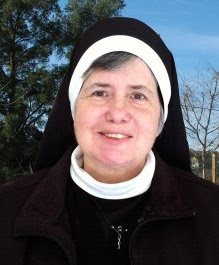 Sister Laurel: The eremitical life is a gift of profound love, wholeness and sanity in a world which lacks this so very often. I understand it as a life which takes human brokenness and weakness and allows them to be touched and transformed by the grace of God. “My grace is sufficient for you. My power is made perfect in weakness.” Probably every vocation does and says this, but I am not sure there is a more vivid example than that of a hermit who lives with, from, and for God alone, and comes to love others as much as possible only through and in God. We live in a world where people are often isolated and distrust the preciousness and meaningfulness of their own lives. The hermit says there is no need to doubt or distrust these things, especially if one is not rich or successful in worldly terms. God alone is sufficient for us, and if we can let that be true our lives have an almost infinite meaningfulness and import — no matter what the world says about such things!
Hermits like to see themselves as the heart of the church silently and steadily beating away at the core of things, mediating God’s grace to church and world. The hermitage is a small but powerful cell in the reality of the coming Kingdom allowing in it’s own tiny way, heaven and earth to interpenetrate each other. A gift to church and world calling each to their very best selves? That is what I think the hermit vocation is about.
NL: What would you say to someone considering the eremitical life?
Sister Laurel: Good question. There is no one thing I would say, I guess. The first thing that tends to pop out is WHY??? Some of the things I would advise would include: have a good spiritual director who can assist you to really grow to human maturity and discern what is of the Spirit and what is not. Be clear that your motives for embracing such a life are rooted in love, love for God, for self, and for others. If you have substantial healing of your own to do, get to it before you make any commitments to eremitical life. The hermitage allows for such work to be done but actual commitments to the life need to have that out of the way as much as possible. Get yourself a decent theological grounding ( also as much as possible), and of course, PRAY!!!
Do you have any other questions for Sister Laurel? Even if you are not called to become a hermit, what are some things about hermits that you can (or would like to) reasonably incorporate into your own life?
Archived Comments
- July 21, 2008 at 11:36 am
-
Dear Sister Laurel, I am a single mom. I raised my son in the Catholic faith. We lived near a hermitage and spent time with the hermits who lived there. He is now in his 3rd year studying mechanical engineering and has become an atheist. Please pray for him. His soul is sad and mine is too. A word of advice would be welcomed. God bless you, I love your vocation.
- July 21, 2008 at 4:12 pm
-
Hi Mona, I am sorry to hear about your son. Is he a reader? I can suggest a book (and an author) someone scientifically oriented MIGHT appreciate (and find articulate if Also, I would suggest you learn to speak to your Son of profoundly religious things in everyday (non religious) terms (the real, value, being, truth, etc), and be open to hearing his deepest questions (the ones below the atheist rhetoric). At bottom you will both be speaking of God, but your son won’t be put off by the usual religious language and baggage. Personally I think that usually this stage is pretty normal in young adults and can be a way of outgrowing images (often caricatures) of God that pass for the whole truth when they should not. This is not really a bad thing, but one has to be sure the baby (faith and God himself) doesn’t get thrown out with the bath water!! I suspect this will raise some more questions for you, so please feel free to write me at my own email address.
- April 6, 2009 at 9:26 am
-
There are many ways to live a life as a hermit, and just as many reasons. Regardless, the important thing to remember is to do no harm — not to yourself or to anyone else. Living a life as a hermit can and unfortunately often is an act of narcissism masked within the guise of religion or faith. On-the-other-hand, it can be a life of giving, but in ways not often seen as positive for the world. I am reminded of the Biblical text that says, You are in this world but not off this world. Followed in its strictist sense means that all those who choose to believe with Jesus are to one degree or another hemits. For we cannot live in this world and be part of this world and simultaneously remain true to the teachings of Jesus.
As for the women whose son became an aetheist. I would simply say to let it alone. Neither feel sorry nor mourn or in any way try to intervene. Let He who is wiser than you or me or Sister Laurel or any other living person work things out as He sees fit. Never preach; never be angry; never be impatient; and above all never judge. Simply let it be. Let your faith and your love be your gift to your son. You can not know what is truly in his heart. I have known aetheists who were greater followers of Jesus than many who profess to be. Cast no stone; say nothing; simply give your son all your love.
- June 27, 2009 at 4:29 pm
-
Hi Mona, Not sure if this issue is one that is still troubling you, as I notice this post is from some time ago, but if it is the first thing that comes into my head is Mass. Perhaps have Masses said for him – lots of them! This can do so much good.
I knew a young man who tried to kill himself. He was caught and taken to a facility, but he kept insisting if he left he would still kill himself (although to the psychologists he said otherwise.) My first thought was prayer and Mass.
Because it was an emergency, I knew contacting a local Church would not work – they have waiting lists that are far too long. Instead I called a nearby monastery and asked the priest to say a Mass, which he did the very next day. I also asked two congregations of nuns to pray him (I did not know one of the congregations, but figured it could not hurt to ask them. They were even out of state, but when I called were willing to pray.)
With all of these prayers, and the prayers of those in his family, etc., he began to say he wanted to get better and live. Thank God he is still alive today.
Prayer and Mass are both so powerful. And sometimes it can take time – maybe years. Saint Monica prayed for many years in regards to her desired conversion for her son, who is now known as SAINT Augustine.
Enlist some spiritual aid, persevere as long as needed, and God will answer. There is a parable in the Bible of the woman who knocked at the door of a home, but the man would not answer. But she knocked so long and persistently that he finally got up simply because she would not let up.
- July 4, 2009 at 7:07 pm
-
It seems that many people (young and mature, Protestant and Catholic) are having problems with the faith they were raised in. Their reasons are many. And this can cause a lot of problems within the the families. I have noticed that some family members are tempted to be more embarassed by what others think about this situation than trying to help their loved one find their place in God’s plan. So what I have advised families with this worry is … don’t worry. God loved your son two thousand years ago so much that He sent His own Son to die for your child. The reality of God and God’s love is manifested in your daily life. As you walk closer to Jesus, your son can’t help but see what Jesus means to you and no athestic argument can stand the test of a Godly parent. I told one parent whose adult child was angry with God that the child actually had great faith. But his faith was like a tee shirt that the son had put on inside out and backward. It rubbed, chaffed and itched, but he still had a tee shirt. Eventually God and the son would get it on correctly — right side out and front side front. God bless you both.
- September 6, 2009 at 10:43 pm
-
Ive tried living isolated like a hermit but Im not a monk. Because of a struggle I found myself living alone and I was blessed and accomplished so much during that solitude. Am I called to be amonk,hermit or a priest?
- January 15, 2010 at 10:37 pm
-
Dear Lee, I agree with Sister Julie here. Some degree of solitude is necessary for every person, and on a regular basis. It is like the rests in music. Without them we have only noise. With them we have music. Most people however are not called to a life of solitude, but when they are it is a very positive thing for them which helps them become whole human beings, capable of loving others and themselves. Also, when they are, there will be a yearning for it which is rooted in love, not in insecurity, or fear, or anything else which is negative, for instance. I would suggest you give yourself time for regular solitude (a day per week, for instance if that is possible, as well as a little each day) and see where it leads you.
- April 10, 2010 at 5:20 pm
-
There are many ways to live a life as a hermit, and just as many reasons. Regardless, the important thing to remember is to do no harm — not to yourself or to anyone else. Living a life as a hermit can and unfortunately often is an act of narcissism masked within the guise of religion or faith. On-the-other-hand, it can be a life of giving, but in ways not often seen as positive for the world. I am reminded of the Biblical text that says, You are in this world but not off this world. Followed in its strictist sense means that all those who choose to believe with Jesus are to one degree or another hemits. For we cannot live in this world and be part of this world and simultaneously remain true to the teachings of Jesus. As for the women whose son became an aetheist. I would simply say to let it alone. Neither feel sorry nor mourn or in any way try to intervene.
Dear Jonas, In the sense in which the Church uses the term hermit (which is not the same as the common sense) I don’t think narcissism is a particular problem. I say this because the heart of the vocation is love, not misanthropy, and the fruit of genuine eremitical solitude is a generous and authentic humanity. It might be the case that with lay eremitical life this is more of a problem than it is with diocesan eremitical life since lay hermits tend to self-identify as “hermits” and the church is not involved in the discernment or mediation of such a vocation. I think you are correct in identifying this as a danger, and something which should always be weeded out, however, — as much a danger to authentic eremitical life as to those touched by it. I would suggest too that every person is, to some degree or other monos or monachos (“one” or “solitary” from whence we get the term monk), but I would not use the term hermit for this. I say this because isolation or existential aloneness is not necessarily the same as eremitical solitude (isolation in particular is not the same thing).
Further, I think we need to be careful in defining our use of the term “the world”. Do we mean God’s good creation of time and space and all that is part of it, or do we mean, that portion of this creation which rejects or is resistant to Christ, for instance? We are always both in and of the world in the first sense, but of course, not in the latter sense. Thus, lay persons, or those belonging to secular institutes radically belong to and in this world (God’s good creation) while being even more radically from and of Christ as well. In fact, their belonging to and in this world is intrinsic to authentic discipleship for them.