Wondering how God is calling you? Are you curious about how your job or set of relationships is really a vocation? Do you want some awesome discussions around faith in real-life and more? Think hanging out with Catholic sisters and a fun thoughtful, faith community is cool? Then you are in the right place! Welcome! Explore and be sure to visit with us every weekday at 6 pm CT in our chat room.

Investigation of U.S. Catholic Religious Sisters

by Sister Julie on October 7, 2009  J.M.J.A.T.

in blog post, NUN 101

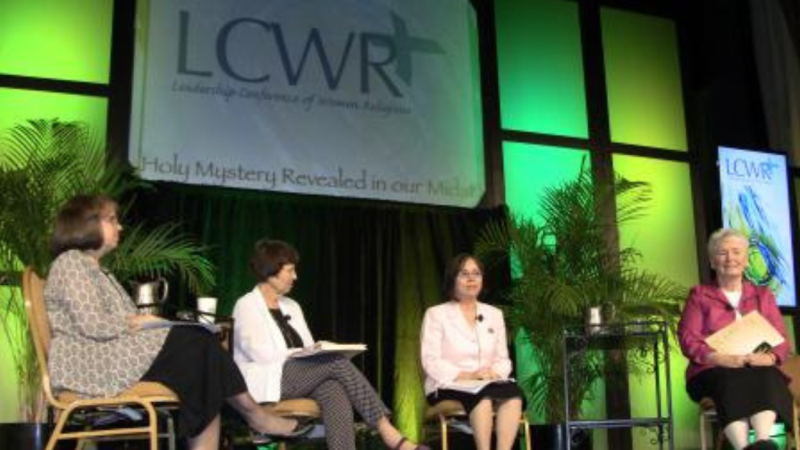
The investigation of women religious (aka Catholic sisters or Catholic nuns) in the United States has raised many questions and concerns since it was first announced earlier this year. Here at A Nun’s Life Ministry, we’ve received a number of questions about the Apostolic Visitation and the doctrinal assessment of the Leadership Council of Women Religious (LCWR), an organization representing 95% of women religious in the United States. Because of the concern that so many people have shared, we’d like to open the door to your questions so that we can begin to address them with the help of experts in the field of religious life and the Catholic Church.

We would like to begin gathering your questions about the investigations. Some of the questions we’ve already received touch on the following concerns:

  • why are sisters being investigated? And why only in the United States?
  • is this Apostolic Visitation like the Visitation of the Legionaries of Christ?
  • why are sisters upset if they have nothing to hide?
  • who are Cardinal Rodé and Mother Mary Clare Millea?
  • is this a friendly visit?
  • why aren’t contemplative nuns and religious brothers and priests being investigated?
  • should this be of concern to me as a lay person? as someone who is ordained? as a religious who is not being investigated?

In the next few weeks, A Nun’s Life Ministry will be collecting your questions as well as creating a resource page with information on the Apostolic Visitation and the doctrinal assessment. We welcome all respectful questions. Please use the comment box below or email us at with your questions. We’ll keep you updated as we go along.

***

Here’s today’s Praying with the Sisters podcast on a passage from today’s liturgy. Click on the “play” button.

Get A Nun's Life blog posts via Email:

{ 44 comments }

Another Sister Julie, CSSF October 7, 2009 at 2:18 pm

Excuse me if I’ve said this before, but I say, Bring it on! The results will show that we have been and continue to be the workhorses of the Church in the US, doing the lion’s share of the work in education, healthcare, social work, retreat/prayer ministry, justice and peace issues, etc. And not only are we the workers, we are also the dreamers, the visioners, the dancers, and the mouthpiece of the voiceless–all of us working the bring to birth the Reign of God among us.

Sr. Mary October 7, 2009 at 2:23 pm

Dear Sr. Julie,
Although I don’t always agree with your viewpoint, I have really appreciated this blog because of the moderate and fair viewpoints you always try to present. It seems that there is always room for everyone here and that you try to objectively and sensitively present a lot of issues, especially issues about religious life, and issues that other people wouldn’t touch, including the apostolic visitation. That is why I’m disappointed that you would refer to the apostolic visitation as an “investigation” right in the title. I think that words are extremely important and “investigation” has a very negative connotation. It projects a certain attitude and judgment onto the visitation that I personally do not believe is warranted at this point.
“Investigation” is not at all accurate to describe this apostolic visitation. One of the things I have appreciated about this blog is that people are free to dialogue and are respected for their opinions but I think using such a charged word from the beginning does nothing to foster Christian unity or respectful dialogue. The Church has said that the apostolic visitation is to assess the quality of religious life in the United States. I know that this makes many apostolic religious nervous and it is definitely lacking in specifics. I am not at all saying that those feelings do not have a right to exist. They do! However, I think that there are more appropriate ways to express that feeling than to add more misinformation. As far as specifics go, all religious have received the questionnaire providing in detail what parts of our life the visitation wishes to explore with us (they are personal, communal, and ecclesiastical reflection questions), and included is a list of all the various documents of the Church that refer to religious life. If any religious in the United States wants to know what is happening in the visitation, all we have to do is read Vita Consecrata, or Fundamentals of Religious Life, or Perfectae Caritas. My hunch is that the Church didn’t put forth these beautiful documents on religious life to place burdens or rules upon us but to give us her wisdom, support, love, and gratitude. What reason do we have to doubt her intentions? I hope that this is read in the spirit of charity in which it is written because I am very grateful for your web-presence and I know that the ministry you provide here is very important to many people.
in Christ,
Sister Mary

Sister Julie October 7, 2009 at 3:50 pm

Hi Sister Mary, Thanks for your feedback and for addressing this issue so that I can clarify. I’m using the word “investigation” as it is defined in Merriam-Webster “to observe or study by close examination and systematic inquiry; to make a systematic examination; especially : to conduct an official inquiry”. The website of the Apostolic Visitation and the Instrumentum Laboris clearly shows that this is indeed an official visit, one that is both formal and personal, and also that there is a systematic approach to this visitation. Because, as you noted, this is a topic that “other people wouldn’t touch” it’s very difficult to find neutral language to describe the reality. On the one hand the language of “visitation” can be problematic to some because they perceive that it minimizes the seriousness of this event which is reflected, for example, in the in-depth questions of the second questionnaire. On the other hand the language of “indictment” is problematic to others who consider it a legal term suggesting that a crime has been committed even though Cardinal Rodé has not accused anyone of a crime. Is it “misinformation” to call this event an investigation? I don’t believe so. Nor is it meant to be negative. I hope that you understand my use of this term and continue to participate in this important conversation.

RICHARD SALUTE October 7, 2009 at 3:54 pm

Why does it seem that the church has so many problems with women.

Sister Gayle OSF October 7, 2009 at 3:58 pm

I just read over the questions and at first glance do seem to be leading. I can’t say much more as yet, but it will be interesting.

Sister Julie October 7, 2009 at 4:34 pm

Hi Sister Gayle … the questions here aren’t meant to be leading. They are simply examples of questions we’ve received. We hope that people feel free to ask any kind of a question here doing so of course with respect for everyone.

Hi Richard … thanks for writing. Will add your question to the list.

Jack October 7, 2009 at 7:17 pm

This is a most interesting topic to me also. I agree completely and totally with what Sister Julie, CSSF wrote. I, too, have used the phrase work horse when describing Catholic sisters.

Richard, I think the Church has so many problems with women because, for the most part, the guys holding the power are a bunch of old white men who don’t like the idea of women being able to do things without them. For centuries men controlled the lives of women–even those in convents. Now the Church is trying to figure out how to control a group of people who no longer need their control.

Sister Julie October 7, 2009 at 10:45 pm

Hi Jack … the issue of women and the church hierarchy is a very long and complex one, a bit too much to chew off right now! But you and Richard both seem to be questioning the role of gender (with its long history) in the current situation.

Michael Hallman October 7, 2009 at 10:55 pm

Hi Sister,

Mostly I want to stay out of this discussion, but I do think to keep things in perspective it is helpful to note that it was indeed men who were investigated first, in the visitation to the seminaries. The results of that investigation and visitation have not yet been implemented into any concrete action, but we can be assured that such is forthcoming.

I just think there is too much of an attitude that the Vatican is “picking on the women,” and sadly there is a great amount of unhealthy hysteria surrounding this visitation (in the comments to one of Sr. Sandra’s articles over at NCR I can’t tell you how many times I read the ludicrous claim that the purpose of this visitation is to force all women’s religious back into the cloister…ugh), and so I think to balance this hysteria it is just helpful to note that this is the continuation of a series of investigations, visitations, and assessments by the Vatican. Lest we forget, as Catholics we do submit to a chief shepherd in the Pope, the vicar of Christ, and sometimes we have to let him do that job. Instead of opposing him or his Vatican representatives, as some are suggesting that the women’s religious here do, perhaps we might encourage simple openness, forthrightness, and trust in the fact that it is the Holy Spirit who guides this Church, as promised by Christ.

Ha, okay, so much for me staying out of it :) Anyway, regardless, I do know that this is a cause for stress for many of the sisters, and so please do know that you are all in my prayers.

Peggy October 7, 2009 at 11:17 pm

I agree with both Sr. Mary and Sr. Julie that language is important. That is why I get uncomfortable when people use “church” when it seems that they are really talking about the Pope, the Vatican, or the hierarchy. After all, we are all part of the “church,” and yet much of what is referred to when speaking of the “church” does not seem to refer to the body of Christ or the faithful at-large, but to those who have official leadership positions.

Meanwhile, I do have two questions, and I don’t mean for them to be incendiary. But why are those responsible for the visitation all seemingly from communities affiliated with the CMSWR, which includes about 10% of sisters in the US, and none seem to be from communities affiliated with LCWR, which represents about 90%?

Also, what is the relationship–official or whatever–between the visitation and the other investigation (and I think the term is accurate here, in Sr. Julie’s definition of the term) of LCWR? Is it mere coincidence that these are happening simultaneously, and that the communities being “visited” are primarily if not entirely LCWR-related communities?

Joan O P (Australia) October 8, 2009 at 1:13 am

Dear Julie,
I was pleased to have the link to the second part of the questionnaire. What the intention is I don’t know but I feel with/for the 59,000 Sisters being visitated. Much of the information would already have been submitted to Rome after each Chapter of each congregation. What this is doing reminds me so much of the bureaucratic form filling I have had to do in regard to different government systems in my 30+ years of education programmes of families with deaf children. That used to take up so much of the time which should have been spent actually interacting with those families. Each year I was only repeating what I had sumitted the year before.

I found Peggy’s last question fascinating. I do not think we have two bodies representing different groups of Sisters in Australia.

I repeat that you are all in my prayers.

Sue October 8, 2009 at 3:30 am

Sr.Julie
I’ve been thinking about this question .Everything to do with current Religious life came about via Vatican 2,correct?? Pope John XX111 moved the church out of the dark ages,& Religious are just following his”program” so to speak.Are they trying to overturn Vatican 2 or something? If they make changes in Religious life to be pre-Vatican 2,does that mean the’ll be bringing back latin Mass with the priests back facing the people again,no expression of peace to one another,no altar girls,no laity assistance with communion.Do they want to use latin Mass so only few will understand??What do you think is the reason for this “visitation” I think the sisters due great things for our church,I’ve not heard of a sister being charged with any crime,maybe the visitation should be at semanaries&rec-
tories,or is that who is doing the visitation?Sorry for the multiple questions but I can’t see why anyone at the Vatican needs to be watching our sisters here.Thanks,
Sue

Katie October 8, 2009 at 7:44 am

Sue (Comment #10), I am right there with your very politely posed question wondering why sisters from the minority group (CMSWR) seem to comprise most of the visitation group. I haven’t found a satisfactory (or even initial attempt) explanation to this question. I have merely cited your same observation and been left wondering. For what it’s worth, Mother Clare’s community (Apostles of the Sacred Heart) belong to both the LCWR and the CMSWR.

Regarding your second question, there is no connection between the Apostolic Visitation and the Doctrinal Assessment. Their timing is merely coincidental. Both “investigations” come from Cardinal Franc Rodé, prefect of the Congregation for Institutes of Consecrated Life and Societies of Apostolic Life. However, Mother Clare Millea, ASCJ is the Visitator for the Apostolic Visitation and Bishop Leonard Blare (Toledo, OH) is coordinating the Doctrinal Assessment. Hope that helps clarify.

Sarah October 8, 2009 at 10:03 am

My first question may be a little off topic but it is in regards to the article that Sr. Sandra Schneiders wrote in response to the Apostolic Visitation called “Discerning ministerial religious life today”. What is the difference between her definition of ministerial Religious Life and the calling to a secular institute?

I would also love to reflect together about the Vow of Obedience. (Canon Law. 601 The evangelical counsel of obedience, undertaken in a spirit of faith and love in the following of Christ obedient unto death, requires the submission of the will to legitimate superiors, who stand in the place of God, when they command according to the proper constitutions.)

I believe that the constitutions of most Communities of Pontifical right includes the acknowledgment of the role of the Magisterium. So my question is how does the vow of obedience affect the way that one may perceive this Visitation.

Blessings, Sarah AMJ novice

Sister Gayle OSF October 8, 2009 at 11:04 am

Oops, let me clarify. I wrote that previous comment too quickly. I meant the questions in the questionnaire that was sent to the communities, or “units,” as it calls them. Those questions are quite specific in their direction.

Michael Hallman October 8, 2009 at 1:12 pm

Sue,

Part of the problem is a tremendous misunderstanding of Vatican II itself. Not everything that we see changed in the Church is actually a fruit of Vatican II. Also, you have gravely mischaracterized the Council as “bringing us out of the Dark Ages.” And your assessment of the Mass reflects a poor (but common) understanding of ad orientem, where the priest doesn’t “have his back to the people,” but rather, in certain instances, faces together with the people towards the tabernacle, towards the symbolic East, in anticipation of the return of Christ. It is an eschatological posture, and contrary to what most people understand or believe, it is the same posture that is presupposed in the documents of Vatican II. The change to versus populus, where priest and congregation stand facing each other, actually does not come from Vatican II, but rather came later on, and is not a mandate at all, but only optional.

As far as Mass in Latin, no, the Church is not looking to force a full Latin Mass on everyone, though thankfully those who desire the Mass in Latin may still find it (and again, the Mass post Vatican II has still frequently been offered in Latin, even under the new rite, the novus ordo). However, Sacrosanctum Concillium, the document on the liturgy that came from Vatican II, again indicates that Latin should still retain a place in our Masses, even if many of the parts of the Mass are translated into the vernacular.

The unfortunate reality is that so often people speak of being in the “spirit of Vatican II,” or that the modern Mass we celebrate today is the “Vatican II Mass,” or that many of the reforms that have taken place in religious life are simply that which is called for by Vatican II, when in fact quite often all of the above are incorrect. It is difficult to be in the “spirit of Vatican II” while directly contradicting the documents of Vatican II (how often to you find Gregorian chant in the modern Mass? Yet Vatican II explicitly calls it the music proper for the Mass that must always hold pride of place); the common modern Mass is often filled with changes and innovations of made by the priest, yet Vatican II explicitly forbids the priest from changing anything from the Mass of his own authority, but rather that he must preside over the Mass and pray the Mass as it is handed on to him by the Church. This unfortunately is ignored far too often, and as such, many modern Masses are not Vatican II Masses at all, but rather “innovations” that directly contradict both the spirit and the letter of Vatican II. The same is true with many occurrences of modern religious life. The changes that we have seen often have no reflection whatsoever in what was called for by Vatican II, and they too reflect neither the spirit nor the letter of the council.

Far from looking to turn back before Vatican II (a council that is a continuation of a 2,000 year tradition, rather than a rupture from tradition that began something new, as some would have us believe), what is sought now by the current Holy Father is simply a return to Vatican II, a proper implementation of it, and the hope is that men and women religious, lay persons, priests, bishops, will all come together and work together as a Church in respecting Vatican II, in allowing our pastors and shepherds to do their job in guiding us towards becoming a Church that fully embraces the authentic Vatican II, instead of everyone trying to assert their own independence in a way that contradicts and betrays our Catholic identity.

jean October 8, 2009 at 5:05 pm

Hello All – Sister Julie, I am so grateful that you all have opened this discussion. I have been waiting for it and expected – trusted – that, sooner or later, you would take this step. THANK YOU.

My eye, like Sister Mary’s, was immediately drawn to your choice of the word “investigation” in the title. Your explanation makes sense to me and I certainly think the word choice is justified by Webster’s. Nonetheless, “common use meanings” tend to rule interpretation in highly charged conversations and, most especially (I think), in the blogosphere.

I, too, was disappointed and concerned that this could be become – like most other discussions in the etherworld – simply one more ideologically-filtered and -driven fracas, however politely participatnts might edit themselves. I don’t believe that was your intention. I share in the general concensus here that you are committed to and skillful in facilitating open dialogue. And I do think that the choice of the word “investigation”, in this very specific and emotional context, was unfortunate and gives the appearance of an ideological slant to this terrific resource you are extending.

I am not well-educated in the history of the Roman Catholic Church but it is my understanding that “Visitation” and “Visitator” have very Roman Catholic-specific meanings. And that these terms to do not, not in the slightest, suggest that these events are social in nature. I am thinking, in particular, of Teresa of Avila’s experiences with Visitations. I had no sense that she was “visitated” for the pleasure of her company!

Why not just stick with the actual language and immediately thereafter provide an explicit definition of this Roman Catholic term? To do so allows the discussion of the event to remain focused on the very specific context in which it is occurring: the Roman Catholic Church and its Vatican-centered hierarchy, with which with American Roman Catholic sisters maintain a voluntary canoncial relationship in the year 2009.

I use these terms because they are the only intellectually honest terms of which I am aware and, as such, I see no reason not to stick with them and start from there.

I am aware that those terms very often lead to the immediate assumption that I approve of the Visitation in all its particulars.

And it is that assumption – and not the terms themselves – which is the problem.

So very little has been written that it is not ideologically loaded. A place to start, I think, in ending that uniformly destructive dynamic is with a commitment to fidelity with our language. There are two events. Each has a very specific title. The history of the Roman Catholic Church provides context-specific definitions of each of those events and titles. Any writer or speaker who deviates from those terms communicates meaning, wittingly or not.

My assumption, when a member of the Roman Catholic commmunity substitutes the word “Investigation” for “Visitation” and/or “Doctrinal Assessment”, is that this particular Roman Catholic writer or speaker is antagonistic to the Visitation and/or Doctrinal Assessment.

That assumption may well be incorrect. But it my belief that words are not only important; they are meaningful and powerfully so. And I discern very specific meaning when a Roman Catholic media source uses the word “investigation” rather than the officical language followed by an explicit, concrete and contextually-consistent definition of that language. And THAT reality tells me I am reading an opinion piece.

One more note on language: Peggy, I agree with you about who “church” or “the church” is. That said, Sister Mary referred to “the Church” and that, in mind, refers to the institutional Roman Catholic Church. Two related and yet very distinct entities and, thus, issues or discussions.

Jean

(For the record, I do **not** approve of many of the particulars of the Visitatation).

As I noted in response to Sr Sandra Schneider’s use of the “grand jury” analogy, I think arguments that seek to evaluate this event in other contexts are faulty, at best.

jean October 8, 2009 at 6:47 pm

Which specific questions do some experience as leading? Some on the Visitation’s questionnaire or questions listed above?

I agree with whoever wrote that some of the questions the Visitation poses probably do amount to that redundant process known throughout the professional world as “filling out forms” and “providing the same information in nineteen different contexts and ways”. That is always a complete drag and rarely is it a hostile or threatening action and, in my mind, it is silly to waste any time on that commonly experienced pique. (I read a fabulous article in Vanity Fair about the least bureaucratic information-gathering tool known to modern man: the one used by TARP to grant bailout money to banks. Basically, the form – reproduced by photo in the article said: “Who are you? How much do you want? Will you consider paying it back? No? How soon can we give it to you?”. My point: some amount of bureaucracy saves our bacon and an absence of some bureaucratic nonsense in our institutional lives should cause us to slow down, way way way down).

That said, I think the Visitation’s questions are very straightforward and are consistent with the stated focus: what is life like in apostolic congregations these days.

I am with Michael Hallman in rejecting the suggestion that the goal is to return all sisters to the cloister or to nab financial resources. I think it at the least alarmist conjecture (I think Sister Schneiders, in one of her articles, also dimissed these proposals) and I think more likely that this is simply just plain untrue and, thus, not worthy of anyone’s time or energy.

I do think many sisters are correct in recognising that the spotlight of these specific questions will shine on them. The questions will quite obviously elicit a factual accounting of where sisters are living, with whom and how; and the specifics of how the vow of poverty is lived will be detailed. I am very sure that many circumstances that will be complete unremarkabe and others that will be a surprise to run-of-the-mill Catholics will be recorded.

How do sisters feel about that?

Jean

Peggy October 8, 2009 at 11:59 pm

To Katie (#13): The investigation of LCWR is NOT under the auspices of the CICL, but under the Congregation for the Doctrine of the Faith. That being said, I find it hard to believe that the 2 inquiries (I am trying for a neutral term) are merely “coincidentally” timed; none of my research leads me to that conclusion. Sorry. I would need more evidence to be persuaded.

As for my query about the term “church,” it was Lenny Bruce who said that the Roman Catholic Church is the only “The Church.” Again, in the interests of linguistic precision, the hierarchy is not the church, upper or lower case. And use of those terms as synonymous, at least for me, simply reinforces an ecclesiology and a concept of authority that I find rather problematic.

Finally, not all the changes in religious life that we are talking about proceed from Vatican II. Many of them are rooted in earlier sources such as Sister Formation, and even some of the calls for renewal (beginning in 1951) from Pius XII. Then there are prophetic works like “The Education of Sister Lucy,” by Madeleva Wolfe, CSC, going back to the 1940s. Anyway, these are the kinds of things that helped lay the groundwork for Sister Formation, which in turn inspired the precursor to LCWR (again, before Vatican II). Sisters were well on their way long before the Council–and that is perhaps why they were the group within the church to respond most fully to the call to renewal, in the view of most historians….

jean October 9, 2009 at 12:57 am

More an observation than a question:

One of the things that has been most remarkable and most uncomfortable to me in my discernment process is the way my Catholic friends and family have responded when I have described my discussions with and visits to various communities. I have my own questions but I have really been struck, as I have described my days during visits to various orders, by their various looks and tones of confusion, followed by direct questions:

*****They took you out to dinner where?! How much was the check?!
****You did not go to Mass or celebrate the Eucharist *once* on a weekday?! Was there no time?! Couldn’t you have skipped ___ to go to Mass?!
****What is this? This prayer, on this piece of paper stuck in your book? It kind of sounds like “the Glory Be” but it refers to “Source”? What is that about?
****So they share your belief that the Church’s teaching on homosexuality will eventually change?
****What do they think about ordination? Some of them don’t go to Mass because they believe the Church is wrong about that?!
****Did you just say one of the sisters you visited with has not lived in community for more than 15 years and has, instead, shared a home with a woman who is not a relative and not a Catholic sister?! What?!
****Wait. You and the sisters had coffee and a muffin right before going to morning Liturgy and right before receiving Eucharist? Did you ask about it? And they said “yeah, that’s what we are doing”?!
****Wait. A blessing before a meal seemed sort of optional?
****Wait. Wait. Wait. Wait. Wait. It has been a gut-wrenching experience for me.
I feel like I want to protect the sisters – the same way I want to protect any person from the censure of strangers – by essentially cherry-picking my facts….
….AND I feel a deep sense of compassion for run-of-the-mill “average bear” Catholics, many of them wholly unconcerned by the habit issue and all of whom revere with the deepest conviction the sacrificial work done by the sisters, past and present; most of whom cannot reconcile this stuff with Roman Catholic religious life; faithful Catholics who don’t recognize this stuff and are quite sincerely shocked that this is what I experienced “at the convent”.
They are so confused by what I experience “at the convent”, and I do not know how to respond to this dismay on the part of faithful Catholics.
NOR do I know how to respond to the anti-Catholics and atheists in my world who just laugh at it all and ask, “What the hell are you thinking of, Jean?”
I know this sounds resentful and I am sorry for that. There is no disrespect meant. This does truthfully reflect how I am feeling: stuck between a rock (progressive women religious) and a hard place (Mr and Mrs Joe Bloe Cradle Catholic **and** people who do not respect Catholicism).
None of those responses is going to determine my ultimate decision.
What is happening, however, is that I find I am asking myself questions, over and over again, about honesty, about the integrity of contemplating a life about which I experience a conflict when asked to describe the communities and the days I spent with them.
And then I encounter “nun-defenders-on-the-rampage”, as I call them, who deny that I have experienced what I have experienced.
I feel angry because I am asked if these denials are true. I am asked as someone visiting various orders. I am asked as someone discerning life as a sister in less “traditional” orders. I am asked as someone who is academically and professionally trained to describe in detailed and concrete facts what I have observed (in other words, my integrity rests at least in part on my willingness to relay the details even when I wish those details were different). I am, then, in the position of saying that the person denying that I experienced what I experienced is either ill-informed or simply has an agenda that is best met by cherry-picking the facts.
Worst is when the person denying these realities is a sister or layperson who reports that s/he knows sisters and their lives intimately. It is then that I feel betrayed. And that is a terrible experience for me.
I feel a significant amount of relief that these realities- among many other realities – will be documented by the Visitation and shared in the aggregate (facts without names) with the Roman Catholic community. I will not feel like the weight of this conflict in the US Roman Catholic community is on my shoulders. I can describe my experiences (the above bullet points reflect them) without feeling like I am stepping into a field of landmines and betraying someone simply because I am telling the truth.

jean October 9, 2009 at 2:13 am

Peggy, I always love reading you. (And I did check out your syllabi at SU. I would love to take your classes!)

Just want to say I continue to disagree with your argument on meaning of “the Church”, Lenny Bruce aside (I love Lenny Bruce and you for quoting him). “Common usage” and its meanings stand legitimately alongside customary usage and meanings in “the academy” (the realm of Linguistics). There are, thus, several legitimate meanings assigned to a phrase such as “the Church”. You, Sister Mary and I are referring to different usages and meanings. The academy is not the context here. The topic here is Religious Life and the context is the Roman Catholic Church.
Yours is an academic usage and meanting. (I would wager it is also ideological in nature). Mine is plain Roman Catholic “common usage”, in which the average Catholic-on-the-street tends to understand “the Church” as the institutional Roman Catholic Church and “church” as the place, the community, the experience. In my experience, many in Roman Catholic religious life and many academics also understand “the Church”, when used by Roman Catholics, as the institutional Roman Catholic Church. Unless I have misunderstood Sister Mary, she is one of those. And should I enter religious life, so will I be.
I am most definitely Roman Catholic and, as some like to say, “a member in good standing with the Roman Catholic Church”. I disagree with the Church about homosexuality. I believe the Church is wrong on this issue. A significant portion of my church community in the larger cities I have lived in disagrees with the Church on this and other issues. A significant membership of my big-city churches will likely continue to disagree with the Church on this. And we will continue to understand the difference between church and the Church.
I am not being ideological in my usage or meaning. I think you are, Peggy, and I don’t think it is particularly helpful in contexts like this, when most community members are not academics and, though most assuredly have the capacity if so trained, do not read or write with academic sensibilities. It has been my experience, in the professional and academic worlds of which I am both member and dissident, that academic usages and meanings are often positioned (however unconsciously) as more legitimate than non-academic usages. Even in feminist circles. (And that accounts for my dissident member status. I find it problematic in feminist academics and professionals). I do not mean to be disrespectful. I think we have simply knocked up against one of those places where the legitimacy of the academy is, quite strictly, absolutely no more than equal with the legitimacy of the realities of everyday conversation and meaning.
Calling the Visitation the Visitation rather an investigation is simple and clear language and communicates neutrality. I, for one, long for neutral sources of information on this issue.
The very interesting philosophical and ideological (and thus often activist) debate about “what is church” is, indeed, very interesting. But that has no relevance in discussions about the Visitation by the Vatican to religious communities who maintain voluntary canonical relationships with the Roman Catholic Church and, thus, the Vatican. It makes me a little crazy whenever I encounter it. I experience it as a diversionary tactic, even when I doubt seriously that is the intent.

Jean

jean October 9, 2009 at 2:30 am

Peggy, last thought, I think Lenny was making a very funny funny. And speaking of very important stuff, as are you. Just wanted to be sure I do understand what you are saying and I even support it, despite my continued use of the phrase “the Church” when speaking with Roman Catholics. Perhaps it is laziness and perhaps it is also true that this just isn’t something on my radar. As always, I love your presence and contributions here. You, like Sr Sandra, always make me think. Great teachers, both of you. Jean

Sister Julie October 9, 2009 at 10:37 am

Just got home late last night and am now preparing for Nun News Roundup — we’ll talk a bit about this on today’s podcast. Later this afternoon I’ll spend more time with your thoughtful comments and respond too.

Peggy October 10, 2009 at 10:03 am

Jean, you always make me think, as well–thanks!

Just two reasons why I am uncomfortable with “The Church” thing. First, I am *less* uncomfortable with it referring to the “Roman Catholic Church” (more on that in a moment), particularly when it’s being used in a context where most of those participating are in fact Catholics. What I am less comfortable with is equating “Church” with “hierarchy”–as in “The Church believes” or (worse) “Catholics must obey the Church” (which strikes me as syllogistic). OK–so… I obey… ME? Jean ? Mother Angelica? The Pope? My local bishop? See, we are all “Catholic” and we are all “Church.” Frankly, there are some (maybe, in some instances, ALL) *Catholics* with whom I disagree about some aspect of theology, spirituality or whatever. And I hardly expect everyone to agree with me! So when I mean the hierarchy, I say “the hierarchy”–in part because I refuse to cede MY right (and yours, and Mother Angelica’s, and whoever’s) right to consider themselves “Church” and “Catholic,” even though they are not part of, much less the ENTIRE, hierarchy.

As for my *other* problem with “Church” = “Catholic”–it strikes me as going back to the “no salvation outside the (Catholic) church” idea that was condemned with Father Feeney back in the 1950s. [Yes, I know--he was officially excommunicated for lack of obedience, not for the doctrine--I know! But clearly the "doctrine" was at the heart of it--and still is for the remaining sectarian Feeneyites--of which there are several sects, which suggests how NONabsolute their position really is. But, I digress...]

Seriously–I just think this use of “Church”= “Catholic” is very presumptuous in regard to all other Christians, who I believe are also sincere believers and part of the body of Christ. Obviously, I think there is a beauty and validity to Catholicism that transcends the others–at least for ME (I am an adult convert, so I explicitly CHOSE this path)–but…. Who am I to say that this is the ONLY path, or even the best one for everyone? Jesus said that “in Yahweh’s mansion there are many rooms,” and I think that at least partly represents the different ways to God and the different “homes” in which various people can (and, because God constructed that mansion, are expected to) be comfortable and “at home” with God…. Does that make sense?

See, Jean, I am an academic, but I try not to think about these things in a strictly academic way–they’re too important for that!

Gotta run. One of my college housemates is coming for a weekend visit–she’s an adult “revert” to the Catholic church, and one of the things we are going to do is to attend Mass at my wonderful parish tomorrow morning. I hope she loves it as much as I do!

Kathleen October 10, 2009 at 12:28 pm

Since happening upon “A Nun’s Life Ministry” website, I have increased my knowledge of Religious Sisters. The information shared on the website and in podcasts with Sister Julie and Sister Maxine is always educational and often … quite fun.

The Sisters joyfully and enthusiastically share their own day-to-day experiences as well as topics involving Sisters in many communities around the globe. I look forward to reading and listening everyday.

Sister Julie and Sister Maxine truly live the Nun’s Life Ministry mission. As stated, “they are dedicated to helping people discover and grow in their vocation, that is, their life’s calling, by engaging their questions about God, faith, and religious life.”

I am grateful to both Sisters.

As a 50+ woman in a very early discernment process, I am a bit overwhelmed after reading all of the comments here and … in other on-line resources concerning the “Apostolic Visitation and Doctrinal Assessment.”

In my research, I have read about the goal and process related to the Visitation. I have read all of the questions that the Sisters need to answer as well as the many concerns voiced by Sisters … those who provide their names and others who wish to remain anonymous.

It would help if I could read comments from one or more LCWR Sister(s) presenting a favorable view about the “Apostolic Visitation and Doctrinal Assessment? “ Can anyone guide me towards these resources?

Thanks to all for sharing. I lift everyone in prayer.

jean October 10, 2009 at 5:00 pm

Kathleen – As the sisters say, “blessings on your discernment”. I am in my 40s and have been deep in discernment for more than two years now (with years prior in which I refused, “resolutely so”, to quote Oscar Wilde). Feeling overwhelmed has been a recurring part of my discernment process. I have actually gotten to the point that I am sort of excited when it happens: being overwhelmed means I have taken some courageous step, have asked some difficult question, the Holy Spirit has confronted me with a new truth about myself, I am on the verge of a new surrender….in short, I am moving deeper into my relationship with God. Damn drag at times but always fruitful in the end. So, let me correct the sisters, if I may: “Blessings on the MIXED blessing on your discernment!”

This is, for those of us drawn to more progressive LCWR communities, a very challenging time to be discerning. This is a particularly challenging time in the Roman Catholic Church in the US and, by discerning Religious Life at this time, we are right in the thick of it.

I know many would like to say that the Visitation and Doctrinal Assessment have created that tension for discerners and in the community at large. I believe that is a false statement. The Visitation and Doctrinal Assessment have certainly turned up the heat, and the media coverage and the Internet have invited all of us – Roman Catholics and everyone else and their dogs, too – to weigh in. I know that I have to take breaks from reading about it because there is very little written or spoken about the Visitation and Assessment that is not reactive and ideological and rife with assumptions. And I have only so much tolerance for all this(rancorous) conjecture when my faith (let’s face it, a relative of conjecture) is constantly on the table and under my own microscope.

That said, these are real tensions in the Roman Catholic Church in the US and that these tensions were alive and well for years before the Visitattion and Assessment were announced. (A nod to Peggy here but it is my understanding that all LCWR and CSMWR congregations are Roman Catholic – as opposed to American Catholic or or or – and that is why I am referring to the Roman Catholic Church with its institutional center and authority being the Vatican in Rome, with which the LCWR and CSMWR congregations are in voluntary canonical – legal and institutional – relationship).

Those of us discerning a call to progressive LCWR communities were going to get hit upside the head by all of this with or without the Visitation and Assessment. And, in the absence of the community created by the Internet and these public discussions spurred by the Visitation and Assessment, those of us discerning LCWR communities were going to struggle with these head-thumps on our own to a siginifcant degree. With or without these events, I was going to have to confront the reality that what I experience when I visit some LCWR communities is unfamiliar – and very, very confusing – to most Roman Catholics I know. Let me stress again that ALL the Roman Catholics I know continue to revere the apostolic work of the sisters and ALL of them believe that the sisters are faithful to the Gospel in those works. The issue is consistently in the realm of spirituality and practice and, particularly, how the vow of poverty is conceived and lived. (My words are sloppy on this. Trying to avoid the currently inflammatory language “what makes a Roman Catholic a Roman Catholic and not this that or the other thing”).

Kathleen, I would stress to you that there are many, many Roman Catholic religious communities to check out. It is unfortnate for me that the ones I am most drawn to in terms of contemporary understandings of the Gospel may also be among the most divergent from the spirituality and practice of the Roman Catholic Church (again, a nod to Peggy and her concerns). That suggests a complex and overwhelming set of questions and, as a consequence, I wrestle almost daily with the possibility that there can be no integrity ***for me*** in pursuing consecrated religious life in the Roman Catholic Church, or at least not in any of these communities I am looking at. Terrible dilemma but one I cannot, with integrity, ignore. I absolutely believe there is a place for me within the Roman Catholic Church but I am not convinced that I can, with integrity, publicly consecrate my life to the Roman Catholic Church
(ooooh I can just hear the quibbling: “it is NOT a consecration to the Roman Catholic Church but to God” and let me say, in advance, that I think that is not playing it quite straight; if it were, then the orders could be filled with self-defined non-denominational Christians… Please, please, please take it easy on my head today. Yes, religious life is consecrated to God but that occurs in the context of the Roman Catholic Church. If not, then what is the canonical relationship about? Unless I am nistaken, every LCWR and CSMWR congregation has a canonical relationship with the Roman Catholic Church. So please and again: my head, my head!).

I do not see, at this time, how I can consecrate my life to God through religious life in the Roman Catholic Church and and not live the Roman Catholic Church’s spirituality and practices.

It is the same struggle I had about getting married in the Catholic Church: my husband-to-be was at best agnostic and I was a determined “social justice and, thus, cultural Catholic” and I knew we were not going to join in the life of the church after getting married. How, in God’s name (and I mean that figuratively and literally here), could it be acceptable for me to ask the Roman Catholic Church to host my wedding under those circumstances? Under those circumstances, “hosting” is all it would have been. So I refused (which should have told me something: I cannot profane what I do not revere……………….and so here I am, almost twenty years later, finally aware of what I **do** revere and still unwilling to profane it by asking the Roman Catholic Church and community to “host” my spiritual life without allowing it to expect my fidelity to its spirituality and practices).

And I acknowledge – with respect and compassion – those sisters who HAVE already consecrated their lives to God through religious life in the Roman Catholic Church. Questions and observations such as mine could, I imagine, be very painful and very frustrating. I am sorry for that…

And I must maintain my right and need – as must they – to be honest in the way I live and talk about my life as a Roman Catholic woman in the US in the year 2009.

Chin up, Kathleen. However you got here and wherever you go from here, surely God’s hand is in it.

In peace and friendship,

Jean

PS

Kathleen, I too would welcome the comments you seek.

I do want to tell you that I have spoken to many LCWR sisters who are grounded in their faith that the Holy Spirit is alive and well today as much as any other day. One said it seems faithless and foolish to assume anything else.

Others say, “Come what may. we are doing what we feel called to do. If we have to make some new decisions, we have to make some decisions”.

A sister with recognized power said ***directly*** to me (this is a paraphrase), “We do not have enough information to declare for them any unstated agendas and certainly we do not have enough information to know what those are if they exist and, thus, certainly should not be fighting those potentially non-existent unstated agendas”. WHEW! At least one person in power who is approaching this with the caution due any interaction with others. I am not so naive as to believe that this person does not have all kinds of hypotheses and that emotions are not also running high for this person. Only that this person believes that fair play in relationship requires a spirit of inquiry and patience and withholding judgment until the facts are in. Even when we feel the other is not engaged in fair play.
And, let’s face it, there is no reason not to follow the lead of this person I paraphrase and describe above. This is NOT a life or death situation. No one stands before Pontius Pilate here. And, even then, we know how Christ responded…

jean October 10, 2009 at 5:00 pm

Hi Peggy –

Enjoy your weekend with your college friend. I like the language of “revert”. I am one myself and, I don’t know why, the word strikes me as consistent with the tradition of irreverent Catholic in-jokes (and I will stop there).
Your response helped me better understand where you are coming from. Thanks.
It helped me clarify one of my assumptions here and that is that, whenever we are speaking about “religious life” or “US Catholic sisters” or any of these topics, we ARE speaking in a context of the Roman Catholic Church as distinct from all other Catholic churches, distinct from all other Christian communities and certainly distinct from all the other faith traditions that include “religious life” (Buddhists, Jews, Muslims, etc).

That said, it irks me, too, when I hear Catholics refer to “the Church” when they are in “mixed company” with people of other faiths. I want to say,
“Do you see the guy standing next to you? Did you hear him say he is Jewish? And the woman next to you? Did you notice the head covering? And the woman next to her? Did you hear her mention Jehovah? And the man next to her? Did you hear him mention ‘lovingkindness’? And the woman next to him, who mentioned her Baptist pastor?
And, if so, why are you still talking to them about ‘the Church’, as if everyone here is willing to agree that there **is** one Church?”
So I am with you, Peggy: I am not comfortable when Roman Catholics reference “the Church” in non-Roman Catholic circles. It is, for me, just another form of egocentrism, this time expressed (however unconsciously, and I think it often is) on the realm of religion rather than nationality or race or class or politics. It belies the very human and insidious fog in which most of us live our daily lives: “ISN’T everyone just like us?” Most of us rise to the occasion but, whatever water we and our fellow fish swim in, that is the water we tend to think everyone swims in. I think we are often surprised when other fish exclaim, “Hey! Yo, Jean! You swim in SALT water. I swim in FRESH water. And that is the kind of water I am looking for and that is the kind of water I need and that is the kind of water God built me for. So quit telling me that your salt water is “the Water’! It’s your ‘Water’ but it is not mine. For me, fresh water is ‘the Water’.”
Nonetheless, in talking about “religious life” here, in talking about the Visitation and the Doctrinal Assessment, in talking about LCWR and CSMWR, we ARE talking about the Roman Catholic Church. And I think it seems fair, in these contexts, to just let people get on with it and refer to “the Church”. In this instance of all instances, I personally do not think that Roman Catholics need to adjust their language for non-Roman Catholics who may be participating or following these dialogues. This is, quite strictly, a Roman Catholic event and issue. If the rest of the world wants to join us in a discussion of our life, I welcome them. I also believe it is just fine, when they choose to engage with us and even challenge us about our lives, to ask them to understand that we *are* talking about our Roman Catholic lives and, thus, our “RomanCatholicCentricity” is justified and just plain fine and cannot be fairly judged as offensive or insensitive or aggressive.
Thanks, as always, Peggy. I wish I were still living in Ithaca: I would want to pop up one of the back roads to Syracuse and buy you a cup of tea.

Jean

Peggy October 10, 2009 at 10:51 pm

Jean, if you find yourself in the Ithaca/Syracuse area, there will always be a cup of tea for you here. I have a huge assortment, AND a 190 degree faucet (I didn’t put it in; it already was in the house). My tea is your tea….

Marie October 11, 2009 at 4:10 pm

I write to you because I have tried in a prominent Catholic circle for years without success to make my point but to no avail. This so called crisis in women’s religious life is part of a larger crisis. We have to update ourselves for the 21st century. We go to the basics of Christianity to rethink what it is and what is its relevance for our tipping point century. We use biblical-historical scientific scholarship, more developed philosophy, and the advancement of science. From a religion founded in the age of mythology to a 21st century scientific worldview is a long trip. Let’s climb aboard and survey the new landscape. The answers are out there. It is an absolute win-win situation. But that rethinking must be radical and transformative.
A laywoman called Marie.

Jill, ihm October 11, 2009 at 6:56 pm

Wow! I have only been able to skim the comments. Some had wondered about a comment from a sister in an LCWR community? I came across this article in Commonweal:
http://www.commonwealmagazine.org/article.php3?id_article=2658
(thanks to the Nun Network for bringing it to my attention!)

jean October 11, 2009 at 10:26 pm

Sister Jill –

I am making my way through the Commonweal article a second time. I wouldn’t put it in the “favorable comments” column, but I do appreciate it. I had not seen it.

I find this all very sad and cannnot quite imagine what it feels like to be a religious in many of the communities being “visitated”.

First let me say that I am never going to “name names” in a public setting. “Outing” people in any context is an act of personal violence – and I have intentionally never revealed outside of my private world what communities I am checking out because I want to be able to speak about my experience without allowing others to use my words to bludgeon any community or sister.

What is increasingly likely to end my inquiry into consecrated religious life in the Roman Catholic Church is the lack of good old “home truth”-telling.

I have visited numerous communities. I have spoken to numerous vocation directors. I have communicated with numerous sisters.

I have participated in several conversations with sisters in which we joked that a great number of them would need to be “on mission” when the visitators arrive because, facts are, they do disagree with the Church’s teaching on the ordination of women, homosexuality and “the one true faith”. (And that it was a good thing I was still discerning and would not be canvassed because my responses would also be problematic, especially on homosexuality).

The Vatican is on to something factual: there are significant numbers of Roman Catholic sisters in the U.S who actively disagree with Church doctrine. I have met many of them and they have told me they disagree. And that disagreement has coincided with and, in some cases, led to divergent practices. I have experienced that divergence of practice and I have discussed that divergence with many sisters.

I have no opinion about whether the sisters are right or wrong in their disagreement and in the divergence. I am not at all inclined to tell other people what I think of their spiritual practices and most definitely am not inclined to tell them they should do something different.

My experience tells me that the spiritual lives of many US Roman Catholic sisters are, in fact, unfolding in just the ways the Vatican suggests through its Visitation and Doctrinal Assessment. And yet so many sisters seem to be unwilling to just say, “yes, this is who we are and what our lives are now”.

Should it not be in the realm of faith – of all areas in our lives – that we are honest? That we speak our beliefs and share our practices with whoever asks?

I want to say, “Sisters, our beliefs and values always have consequences. One consequence is that, if we are honest in stating our beliefs and telling the full truth about our lives, our relationships may have to change. Our commitments may have to change. Our memberships may have to change. We may have to make new choices”.

I am troubled by my sense that the canonical relationship with the Vatican is sought and maintained but resented mightily and bitterly. I want to understand why. Why ask for what one does not want? It does not make sense to me. I am asking this very sincerely. Why seek (to gain or maintain) what is then resented?

In sh0rt, what – in God’s name – is it all about, Alfie?

Jean

jean October 12, 2009 at 12:56 am

Last thought: I do understand that there are all kinds of related questions about the larger context in which these events are occurring. And I am interested in those. But I cannot help but notice that there is a tendency to re-direct attention to those other questions rather than answering the ones that are being asked.

I do want to say this about the language I am encountering in communities. But let me say first that I am a graduate of a feminist women’s college and all my graduate work was under feminist academics and professionals, and I do expect inclusive language to be used in contemporary settings.

Nonetheless, I do find it tedious when (Catholic) people insist on always calling God “she” and “her”. I mean, come on: one gender-specific pronoun is as limiting as the next. I find I can be a little fatigued by what I experience as relentless political correctness.
In the end, it is also true that I cannot get worked up either way. Jesus was a feminist (in its true meaning) and that’s my concern.

On the other hand, I cannot understand why Roman Catholics would decide to call God “Source” and, as a consequence, pray to “Source” in morning and evening (and other) prayers.

“God” is a gender-neutral name and concept if there ever was one. “Source” is not “inclusive language”. It is not even ecumenical language, in my book. I am not sure how to describe it, except as “new age” language, which I am cool with in new-age ceremonies and literature.

At the convent, I hear “Source” and what follows for me is the voice of Carl Sagan intoning “Billions and billions of stars”, followed by a vision of the swirling atmospheric chaos after the Big Bang.

And I want to say to the nuns, “Ladies! Ladies! This is distracting!”

I want to say, “I am joining you because you are Roman Catholic sisters and I am a Roman Catholic woman seeking to enter relationship with Christ and God my Neighbor and the Holy Spirit and, boom, you start praying to ‘Source’ and I have the Big Bang happening inside my head?!?! And that leads me to thoughts about my favorite physicist Richard Feynman and his beautiful words about the true language of the universe being mathematics, and that leads me to the fact that all my favorite boyfriends (and my husband) were mathematicians or physicists, and then I find myself wondering why none of them is a church-goer? And then I remember that one of them does go and then….

“Source” as synonym for God? In the Roman Catholic community? Why? Can someone tell me why?

When it doesn’t bring Carl Sagan bursting into my head, it forces my attention away from the Gospel and God my Neighbor and focuses me on human disputes (for instance, inclusive language and its caricature, political correctness). I **want** my relationship with God and my Catholic community to connect me to my world. But that is not what substituting “Source” for “God” in prayer accomplishes for me. (The first time, what it brought to mind was the memory of attending a “women’s spirituality circle” in Maine in the early 90s. I was, frankly, irritated by the possibility that I might just have travelled thousands of miles for another one, this time just dressed up as a Roman Catholic convent).

I get what is meant by “Source”, and so does every other Roman Catholic I know (though my stepmother just stared at me and said, “What? ‘Source?’ What does it mean? Well, now, Jean, of course I know what it MEANS but why would Catholic nuns call God ‘Source’ in their prayers? Which nuns call God ‘Source’? ….Oh, and I liked the sound of them so much when you visited. ‘Source’? Really?”)

And, you know, I quite sincerely have no idea why, when it comes right down to relationship with God in its purest sense, Roman Catholics religious women would want or need or feel compelled to substitute “Source” for God in communal prayer. I am, in the end, as baffled as my stepmother is.

Again, I don’t really care if there are Roman Catholic sisters who pray to “Source”.

I am just pretty sure at this point that I will not be asking to join any of their communities. Very hard to say, because I love many of these sisters and I love the work they are doing.

What I feel called to, specifically, is Roman Catholic life and it has seemed that the specific call is to religious life as a sister. It may be, however, that the call is to one of the lay movements, many of which are comfortable with traditional Roman Catholic practice and spirituality and language while also engaging in the world through contemporary and progressive understandings of the Gospel.

Huge dilemma, and one that calls for a great deal of prayer and direction.

Jean

Stephanie October 12, 2009 at 2:04 pm

Hmm, I’ve never heard the “Source” thing before, but it does sound totally distracting. Moreover, it seems so cold and removed… my first thought would have been, like yours, the Big Bang or perhaps something medical, like an IV bag dripping into my arm. I think our metaphors for God must always capture the wholesomeness and alive-ness, and “Source” doesn’t seem to work very well.

At my parish, we just use “God” for everything and it feels very natural to me.

jean October 12, 2009 at 5:37 pm

Hi Stephanie – I have not experienced “Source” at Mass (I would not sit through that a second time, only because I would be using my “Mass time” to attend where God is called God).

I have experienced it in prayers in convent chapels and various communal prayers by sisters.

My experience is that it is not priests but the congregation who is often changing the language. And I understand that there is a link to ordination and an obvious question here about liturgical-language-as- determined-by-the-gender-of-the-person-in-the-pulpit.

But there are other questions and realities. This is not just about priests and nuns, after all. For instance, here is another reality, one experienced and of concern to a laywoman:

What I have experienced in Mass when I visit sisters is “inclusive language”, a striking of the words “Father” and “He”, often in just about every prayer except the Lord’s Prayer. That THAT prayer is left alone has been a relief to me every time. (I did just recall that sometimes “Thou” is replaced by “You” and “Thy” by “Your”. I find it an unnecessary substitution and it is distracting but there you go).

As a consequence, I stumble through almost every Mass and prayer when I visit various communities of sisters because each has its own slight variation in the language of the prayers and music. All around me in the pews, I hear language that differs from the Missal, differs from my catechism, differs from the celebrant, often differs from the Lector and often from pew to pew. For me, it is very disappointing and I spend Mass aware **not** of the oneness of the congregation. I feel much the same way I do when I attend church or fellowship or temple with non-Catholic Protestant friends: every service is different and I feel like a traveller from foreign parts, lonely and filled with a quiet but persistent longing for my own faith community.

“At the convent” where these dynamics occur, my attention is drawn to the difference between whhat is happening and what I expect to hear in Roman Catholic Masses and communal prayer. And that difference is very interesting (and thank goodness for diversity in our world! it is why I am a social worker and why I travel and read and like to live in cities).

That said, it is so very hard – in the space of 30 minutes or an hour -to refocus my energy and attention and mind on the Oneness of God and all God’s creation to which I have come to be restored and celebrate. For me, a real opportunity to participate in all that Eucharist is significantly diminished by my awareness that I need to attend to and try to anticipate each word in liturgy and prayer and music and morning/evening prayer because they may well be different………………….and they are different in each community for a reason and I try to be responsive to the language of the “natives”… and that means I am not focused on the Roman Catholic Mass and Eucharist, which is what has brought me to the convent in the first place. It disrupts my sense that I am in a Roman Catholic Church and tends to end any sense that I have returned to the enveloping and meditative warmth and comfort of the prayers and rituals of the Catholic Church of my childhood. Choral prayer and response – everyone lifting every other soul in prayer as we speak to God and each other in ine voice through the words and rituals of the Lirurgy – provided a much needed experience of unity in world sorely lacking it.

I am left, at the end of these Masses and communal prayers, as hungry as if I had I attended a non-Catholic services. What I have experienced is beautiful and moving. But I remain, during my visits to these “convents”, hungry for a Roman Catholic Mass and shared prayer as taught to me in my childhood CCD and in my RCIA and the Missal and in my adult Confirmation and in my readings about the Mass.

I love a world in which diversity is sought and is seen as the reality of this Oneness that is the human race. I love it so much that I am looking at a Catholic intentional community which hopes to offer hospitality to Muslim refugees and, thus, hopes to provide a Muslim prayer room in the facility that also houses the community’s chapel (where they also hope to retain the Blessed Sacrament between monthly Masses).

But, when we pray and have Mass in the Chapel, we will do so with fidelity to the language and ritual of the Roman Catholic Church………..with every expectation that, when in their prayer room, the Muslims will pray with fidelity to the language and ritual of their Islamic faith and the Koran, etc.

Jean

Jean

Sue October 12, 2009 at 6:46 pm

Reading these comments about the Apostolic Visitation takes me back to the days in the early 1970′s when I explored a vocation to the consecrated religious life. I inquired of many congregations, both active and contemplative, and visited with several.

Why did I not join? I found too much confusion and doctrinal rebellion. I could not reconcile my understanding of Catholic doctrine and theology with what was being espoused by the sisters who counseled me. I felt that I would have to abandon my faith and beliefs in order to join these orders. At the end of my visits, I was shocked and saddened.

For example, I agree with the Church’s teaching against abortion. I do not believe women have the right to choose to destroy a baby. The time for choice is when making the decision to have sex. Yet, most the sisters I met were in profound disagreement. Similarly, on homosexuality, I can find nowhere in my Bible where God does not call it an abomination or approves it. (Please note, it is the behavior, not the person, that the Bible, the Church and I call “abominable.”) Many sisters seemed unconcerned about homosexuals in the priesthood and sisterhood. I, too, encountered many “New Age” beliefs and practices, including “Mother Earth” ceremonies and women-led “Masses.”

One of the things many sisters and several priests told me repeatedly during my discernment process was that the vow they found most difficult was obedience. To me, my first obedience is to God and His Word. This led me to finally drop the idea of being a Catholic sister.

The comments here tell me the same dilemnas are being encountered by today’s discerners. As it turned out, I remained single and live a life of what Thomas Merton called “contemplation in a world of action.” As I continued to study and pray the Scriptures, I eventually left the Church primarily because even the parish priests would not or could not preach the Gospel as it is written. Instead, they pushed their own agendas, often in rank disobedience to the Church’s official teachings.

Today, I have found my home in a small Bible-believing and Bible-teaching Southern Baptist church. Perhaps if the American church returns to sound doctrine and teachings, I would consider returning but not until. My question regarding this Apostolic Visitation is will it have any power to require changes or reforms if the results show certain orders or sisters are in disobedience?

Jill, ihm October 12, 2009 at 8:30 pm

hi all,

I just want to add a clarification to your questions about ‘source’: when you are asking about referring to God as ‘source,’ are you referring to a version of the prayer “Glory be to the Father, to the Son, and to the Holy Spirit. As it was in the beginning, is now, and will be forever, world without end. Amen.”
It has also been rendered as “Glory to you, Source of All Being, Eternal Word, and Holy Spirit. As it was in the beginning, is now, and will be forever, amen.”

Yes, “Source of All Being” (not just source… a small, but significant detail) is another name for God. It isn’t as familiar as Father, but just as Father is A name for God, so Source of All Being is A name for God.

I agree, language we use for and about God matters, and people are very passionate about it. One thing I’ve learned, hanging around my nuns is that those who lived through Vatican II, who really saw great opportunity for reform and openness, it also opened up new horizons for how to name God. The feminine had been ignored for, well, about 2000 years (for the most part), and so there was great enthusiasm over (re)discovering images of God, particularly feminine ones. And, the sisters were studying theology at this time. Which explains, in part, why “she” and “her” and ‘source of all being’ pop up more freqeuently among sisters than the general population.

Stephanie wrote: “I think our metaphors for God must always capture the wholesomeness and alive-ness….” I agree, and where it gets sticky is that what is wholesome and alive for me isn’t necessarily for you, and vice-versa.

There is a wonderful children’s book called “What is God’s Name?” and it goes through all these people saying things like, “I’m a mother, and I call God ‘nurturer.’ I’m a shepherd, so I call God ‘the good shepherd.”….the bottom line is, there are multiple images of God, each one gives life to a person for a particular reason, and each image is AN image of God, no one image is THE image.

Jill

jean October 13, 2009 at 11:14 am

Hi Sister Jill – That is the “Glory Be” I am referring to and one of the uses of “Source”. I like it. I get it. I even think it beautiful language. And I am fatigued by it. When I have been at communities and we would finally reach the traditional “Glory Be”, I had usually spent my prayer time rifling the pages looking for it to ground myself in the fact that I was sitting in a Roman Catholic prayer community, which is my home as much as I am comfortabe visiting other communities. I agree that there are many ways to “name God”: one only need look around at all the world’s religions. In my furstration with “Source [of All Being]“, I have through things like the reality that St Catherine of Siena uses several unique names for God in her “Dialogues”. I love that in individual prayer and writings and poetry . Nonetheless, I am disappointed by and distracted by and alienated as a Roman Catholic woman by these alterations of Roman Catholic names for God in the Liturgy of the Hours and by the all the chaos of these determined and individual alterations and traditional prayer and hymns going on around me in Mass. Again, for me, the beauty of the Liturgy and Roman Catholic prayer is one voice lifted to God in the same words of Thanksgiving. That is lost for me in all of these other words…. THanks for thinking with me, Sister Jill. Jean

jean October 13, 2009 at 7:15 pm

Sr Julie – Hope you are feeling better.

Jean
Thank you for all of this dialogue. It has spurred me to accept what I have known for several weeks: I need to tell at least one much-loved community that I need to end my discernment with them (I am edging up on that time in my relationship with several that I need to commit to one or none). I know that I need to end the discernment relationship with at least one of them. I met amazing women there and I admire their work and their love of God. A series of “the Holy Spirit must be active in this” moments between me, my world and several of the sisters drew me to them and them to me. They have a beautiful history, one of the most powerful I have encountered in the community of Roman Catholic congregations of Religious Women and they are hopeful about the future. I loved my time with them. My time with them was rich and challenging and nurturing. I felt God there. And they made me laugh! I can see myself living with them, sharing ministries with them, celebrating with them the opportunity to be women of faith in the 21st century.
And yet, most days I was there, I was hungry for the Roman Catholic Church. Even in their beautiful chapel. Often, after Mass or prayer, I found that I still wanted to go to the other Roman Catholic Church in town for my prayer and Mass and Catholic community. I did not feel I had “been to Mass” or at least not a complete Mass or, most of the time, that I had been in a Roman Catholic community.
In short, my time with this congregation felt like it could be a good *supplement* to the relationship with the Roman Catholic Church to which I know I am called.
And I know now that my time felt that way because of all the things I have noted: I rarely felt that I was participating in the Roman Catholic Church and its broadest community. I felt I was participating in a faith-based community and a beautiful and loving and generous Christian church with profound roots in the Roman Catholic tradition.
But I was anxious to get back to a Roman Catholic Church.
Thanks again. I can take the necessary step with at least one of these communities because of this exchange and the related one about poverty.
PS
Sr Jill, I am reading the Commonweal article by Sister X again. I am, again, frustrated. Sister offers one explanation – in the context of her sister’s funeral – of why vocations are fewer. But is there **any** evidence to support her hypothesis? Has any of the data revealed that this explanation is consistent with the feedback of discerners or does this explanation reflect very important and difficult issues in religious life which are nonetheless *not* the issues being raised by discerners? I need to read more carefully because it is possible that I have focused too much on Sister’s distressing story about the burial. I think Sister is on to something – I can see why many sisters are angry and disillusioned but none of the published information re: the state of vocations seems to correlate to Sister’s implication when she asks the Vatican at the end, “Now do you wonder why we do not have vocations?”
I experience Sister’s distressing story ****in this context****as a red herrin. And the use of such an emotionally engaging but nonetheless very red herring in this context by this sister strikes me as disingenuous, since it does not seem to bear any relationship to what the data (discerner-generated data) are saying about the current state of vocations. It fits what nuns and “nun-defenders” are saying but, in my experience of the data and even what discerners have written here, it does not fit what **discerners** are saying.
And that is the relevant information, I would think.
Combined with all the other things I have noted, it is just one more bit of information about why I am coming to believe THIS vocation – mine – is probably not a calling to LCWR life.

jean October 13, 2009 at 10:20 pm

Sue (second Sue) – Thank you for sharing your story. “At the end of my visits, I felt shocked and saddened”. Such a hard thing to say when one’s hosts are so kind and well-meaning. But your words describe exactly how I have often felt at the end of my visits.

The casual exchange about breakfast before Eucharist really threw me for a loop. I wasn’t even thinking about the transubstantation question. I was thinking about fasting……especially after a sumptuous dinner and alcoholic drinks and dessert the night before in a spacious, well-appointed, technology rich house. Let me be clear: I love ALL that stuff. But it was not at all what I expected at the convent. And most especially not if we were not going to fast before Mass and Eucharist. A practice of sacrifice is so central to my understanding of Catholicism and I just can’t ***locate*** it in these communities, either in dialogue or *comtemporary* daily habits (with all due respect, I am up to HERE with stories of the sisters’ historical sacrifice in response to questions about sacrifice and the vow of poverty in religious life *today*. I feel manipulated by that narrative when the question is **today** and what new vocations will encounter. It feels like dirty pool and a good old-fashioned Catholic guilt trip designed to silence and, thus, frankly, it pisses me off). So where, I want to ask, is sacrifice LOCATED in religious life if it is not manifested in ritualized sacrifices such as not eating or drinking for an hour before Eucharist? (And is celibacy really the main sacrifice? Everything else looks like choice to me, and that is just the plain hard facts/benefits of life as a human).

You sound happy, Sue, and I thank you for your company. Jean

Sue October 13, 2009 at 11:23 pm

Regarding this visitation,and whether sisters are in or out of compliance with obedience shouldn’t be a mans decision unless it is
the community the man is with. Obedience is to God and your community,not to a visitation team,which I would think should have sisters on it also.I don’t think it is disobedient to change your words in a prayer if that’s what makes you comfortable.A sister does not give up her freedom of speech when she becomes a sister.This reminds me of when I got my very first nursing job which I loved and stayed there for 11yrs,and learned most of what I know today and put into practice each day now.When you work for a hospital system you are obidiant to the facilities rules,policys&
procedures,etc.but there are always issues that come up.I was approached to be told I would work in the surgical recovery room for post abortion care.I informed them I would not take part in these abortions as I was and am still very much against them.They then said that’s right the Pope runs your life.My reply to that was.If the Pope said abortion is ok to part take in,I still wouldn’t have anything to do with it.So I’d be disbdiant to the Pope I suppose.A person has the right to disagree with what they feel strongly aboutThey never tried to force me to assist with the abortions,I didn’t say,”well,I’m leaving cause other people are doing abortions.I stayed and cared for many patients who needed care in several other areas of the same hospital even after being”disobident”I think Sisters have the right to disagree,and even challenge what they feel strongly about.I felt fine about expressing my feelings many times during my 11years there.Each Sister has the right of free speech,and thought.They also have the right to change a prayer as they wish if it brings them closer to God.If praying with a group,I’d bet they use the words the group uses.
Sue

to

Peggy October 14, 2009 at 10:53 am

Sue, I agree with what you have said here, and I think also that we need to be very careful with words like “disobedience.” There is a LOT of writing about what “obedience” means in the context of religious vows–but it’s pretty clear that “blind following of the Vatican” isn’t what it is in ANY accepted definition! In fact, I think that the fleshing out of the meaning of the vows (all of them) is one of the most profound and important aspects of the theologizing about religious life that has occurred in the past half century.

I also think it is interesting that the “Source of all being” rendering of the first person of the Trinity is the work of the Indiana Carmelites, who are, of course, daughters of Teresa of Avila, who is being discussed elsewhere on this site! I have made 2 retreats with this community, and they are clearly a group of women who pray deeply and discern mindfully. One may or may not like the rendering of “Source of all being,” but to view it as somehow less than fully Catholic is, I think, both a distortion and a disservice to these wonderful women.

To learn more about the Indy Carmelites, a very fascinating book is: Mary Jo Weaver, “Cloister and Community: Life Within a Carmelite Monastery” (Indiana University Press, 2002). I highly recommend it!

Maria October 21, 2009 at 4:26 pm

YES, why are the American Sisters the only ones being investigated? I know of quite a few Canadian Sisters who should be investigated for their teachings and adoption of New Age practices.

Sister Julie October 22, 2009 at 11:46 am

Hi Maria, Thanks for writing. You raise an interesting topic … the “new age” thing. Would appreciate hearing a bit more about what you mean specifically because “new age” has so many connotations.

Born before Vatican II January 25, 2010 at 1:17 am

Thank you for discussing this topic publicly. I do want to offer three observations: 1) it is fascinating that so many men are here posting — some might say lecturing — on a site specific to a feminine experience. 2) Visitation is an “evaluation” and Catholic institutions have long been subject to such evaluations; however, this appears different in tone, focus and content. Given that the nadir of scandal in the American Catholic Church involved exclusively male religious — ordained and not — indeed one has to wonder if that is not the catalyst for the page 2 questions. Although a cynic might wonder if how many men answered it; even if it was akin to closing the door after the proverbial horse was out of the barn. And, 3) I happen to have been taught Theology and Philosophy by one of the “architects” of Vatican II. In class, he was specifically asked about the origins of the “modern Mass,” the position of the priest, and the use of vernacular. He told us, specifically, that it was the indeed the intention of the conclave that the priest should “stop turning his back on his congregation” and make the Mass more “accessible” by using the local language. He specifically said that the Mass we celebrated daily reflected and implemented the Reforms of Vatican II. He died in 1999, and told me shortly before his death that he was truly ALARMED and DISMAYED to hear so many “revsionists” devalue these important REFORMS that came out of Vatican II. Now that all these men — the Architects of Vatican II — are dead, there is complete freedom to spread Revsionists propoganda about the intent and results of Vatican II and, indeed, feel complete freedom to dismantle Vatican II, entirely. Pray that does not happen because it will be a radical and rapid departure for the way of life American Sisters pursue today. May God Bless you, Sisters, and preserve your way of life and the important work you do.

Previous post:

Next post: